






























For any institution, admissions are not just a formality at the start of the school year: they determine enrollment numbers, financial stability, and the vitality of the educational mission. Autumn/fall marks the start of admissions campaigns for the following year: open days, initial requests for information and family visits. This is the critical period when key moments are made and also when the most prospective students could fall by the wayside.
Because there’s a long process between the time a family fills out a contact form in October and the time they sign their tuition contract in the spring: follow-ups, visits, application materials, decision, and enrollment. At each stage, without proper follow-up, an interested prospect can fall through the cracks. In international schools, where families often compare several institutions and the decision-making process is lengthy, this risk is even greater. A CRM (customer relationship management) system is precisely the tool that ensures these opportunities are no longer missed.
Why the admissions campaign has become a strategic issue
Student recruitment is becoming more professional. Families, who are better informed, compare options, read reviews, and visit several schools before making a decision. For an international school, competition isn’t limited to the local areas – it includes other international schools, local school systems, and sometimes long-distance learning.
In this context, simply attracting prospective students is no longer enough: you must guide them through the enrollment process. A successful admissions campaign is measured less by the number of applications received than by the conversion rate between those applications and actual enrollments. And this rate depends directly on the quality of follow-up: responsiveness, personalization, and timely follow-ups.
The Admissions Process, from Initial Contact to Enrollment
Understanding this process means identifying where prospects can drop off. It generally breaks down as follows:
- Discovery: The family finds the school (website, word of mouth, social networks, school fairs).
- Initial contact: Families fill out forms, make calls, or request information.
- Admission Process: campus tours, open house, interview.
- Application: Preparing and submitting the application materials.
- Decision: Review of the case, response from the institution.
- Registration: signing the contract, paying the fees, and becoming a student.
Every step is a potential point of loss. A request for information left unanswered for three days, an overly complicated application process, a follow-up call forgotten after a visit—these are all moments when an interested family might turn to another school.
Are you still working with Excel spreadsheets?
Many institutions still manage their admissions using a spreadsheet and a shared email inbox. This may work if volumes are low, but it very quickly reaches its limitations: no automatic reminders to follow up with prospective students, no clear record of communications, information scattered among multiple people, and no overall visibility into the pipeline.
The result: we don’t know how many prospects are at the “visited but did not apply” stage, nor which ones to follow up with first. The campaign is proceeding blindly, and conversion relies on people’s memories and goodwill rather than on a reliable process.
What a School CRM Actually Changes
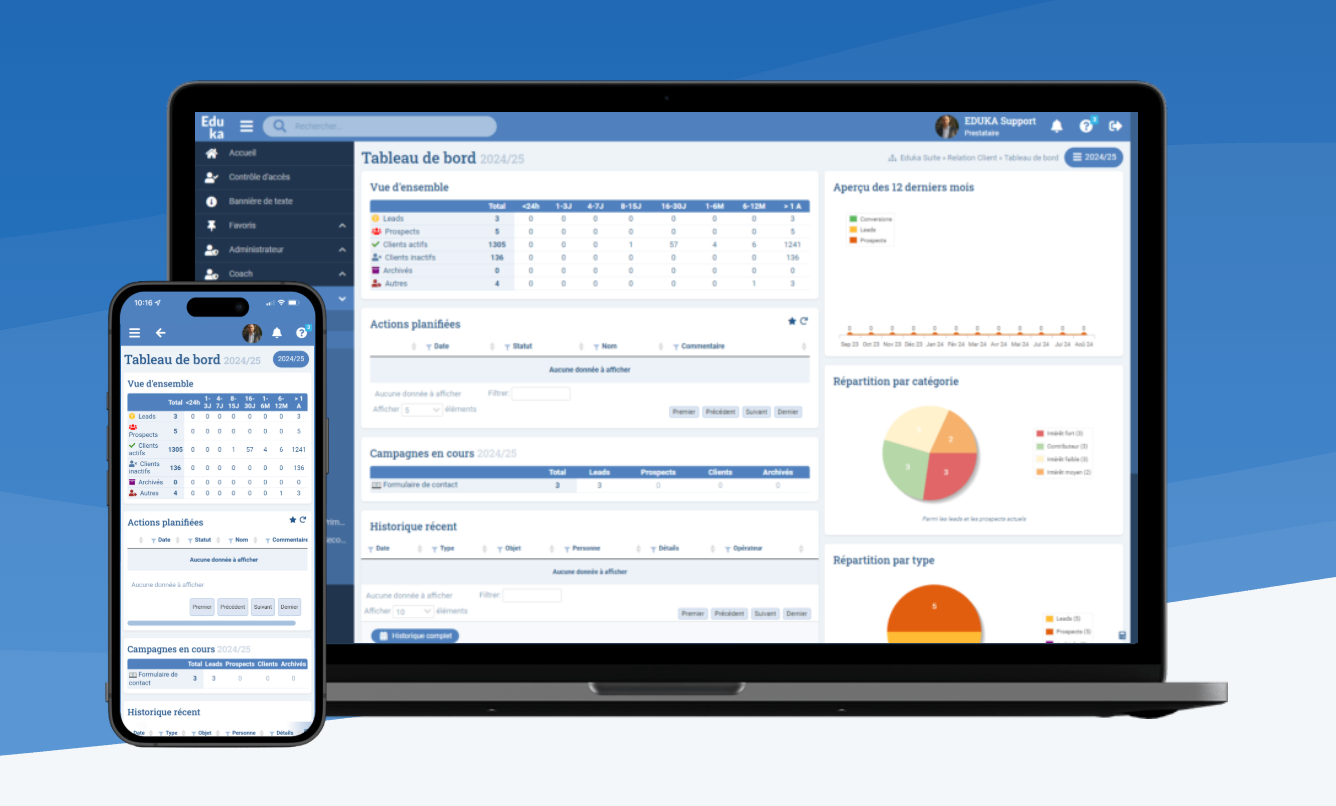
A CRM system designed specifically for admissions centralizes all prospective students and organizes the follow-up process throughout their journey. Specifically, it allows you to:
- Centralize all leads in one place, along with a complete history of interactions and the status of each lead.
- Don’t miss a single follow-up thanks to automated reminders and tasks, so you can reach out at the right time.
- Segment and customize communication based on the target level, language, or stage in the learning journey.
- Automate key emails: acknowledgment of a request, invitation to an open house, reminder about missing documents.
- View the pipeline: See at a glance how many families are at each stage and where the bottlenecks are.
- Measuring performance: conversion rates by stage, by acquisition channel, and by campaign, to adjust efforts accordingly.
The result is twofold: families have a smoother, more attentive experience, and the admissions team works according to clear priorities rather than constantly reacting to situations as they arise.
Best Practices for a Successful Admissions Campaign
Beyond the CRM itself, a few principles make all the difference.
- Prioritize responsiveness: A request for information handled within a few hours is much more likely to lead to a successful outcome than a response delayed by several days.
- Nurture the relationship: A family that visits in October may not make a decision until February. Stay in touch with helpful communications rather than leaving them without any updates.
- Streamline the application process: An online application that’s easy to complete reduces drop-off rates.
- Finally, measure and adjust: Identify the stage where you’re losing the most prospects and focus your efforts there.
From Prospect to Student, Seamlessly, with Eduka
The benefit of a CRM integrated into the school management platform is that it eliminates the disconnect between recruitment and enrollment. With Eduka, the CRM module manages prospects and family relationships throughout the campaign; once a decision is made, the file is transferred directly to the Admissions module and then to the student’s file, without the need for re-entry. The information collected during the prospecting phase (contact information, intended grade level, communications) is automatically carried over to the enrollment process.
The school thus benefits from complete continuity: from the first form filled out on the website to the student being enrolled, billed, and placed in a class. The admissions campaign is no longer an isolated silo but becomes the first step in a unified process.