




























By Emmanuel Bernet, Ph.D.
Léa, in CM1, is asked to ‘learn the lesson on agreement within the noun phrase’. To do so, she rereads the rule. Meanwhile, her brother Noé, in quatrième, revises the French Revolution by copying his notes, alongside other work due the next day.
Both have worked. Yet can Léa apply the agreement rules? Can Noé explain the changes they have studied? These fictional situations prompt us to examine our practice: how can we connect the work we set with the learning we expect?
To address this question, the Lille guides propose a teaching and learning cycle: prepare in class, support outside class, then use the work on return (Carbonnier et al., 2024, 2025). Developed for secondary education, this framework also informs practice in primary education, with tasks adapted to each level. Across the school, leaders coordinate expectations and demands.
In class: clarify what ‘learning’ means
Justifying each task by an observed need leads us to examine its usefulness (Chouinard et al., 2006). In addition, Guo et al. (2024) show that homework can improve academic results in primary education, particularly in calculation and problem-solving. These findings invite us to specify the learning we intend.
For Léa, rereading the rule may help her remember it, but she also needs to apply it. The teacher could therefore ask the class to change ‘un petit chat’ into ‘des petits chats’, then explain which words change and why. Léa would then know what she should be able to explain.
The same issue arises in history: observations in lower secondary education illustrate the gap between copying summaries and constructing an answer. For Noé, the teacher could therefore work through the question ‘What does the abolition of privileges mean?’, showing how to use knowledge from the chapter to answer it.
Before planning work at home, we must also respect the applicable rules: written homework is prohibited in French elementary schools. Léa would therefore practise explaining orally the examples covered in class. In schools abroad, leaders must make the school’s applicable framework clear.
Once these expectations are clear, we still need to anticipate how the work will be carried out outside class.
Outside class: examine what the pupil actually does
At home, seeing a pupil reread or copy does not tell us what they understand. To shed light on their choices, three questions inspired by Eccles and Wigfield’s model (2024) can guide our reflection:
- ‘Can I do this?’ Does the pupil feel able to use the approach taught?
- ‘What is this useful for?’ What interest, importance or usefulness does the pupil see in this work?
- ‘What does this cost me?’ What effort, worries or things they must give up does the pupil anticipate?
These questions also inform our choices. For Noé, a lengthy revision session may leave little time for other work without preparing him for the test. In this respect, Bernet (2026) proposes making it easier to get started through a clear, accessible first step.
Similarly, for Léa, we need to plan how she can check her explanations without depending on an adult. Policies often encourage consideration of families’ circumstances and the help available. The teacher would therefore explain how to try, check and report a difficulty, without asking parents to reteach the lesson.
To share these pointers, Eduka’s Classroom Hub can support continuity:
- Journal: specify what the pupil should be able to do after learning.
- Files: share the agreement examples and history practice questions.
- Contact: enable families to report a difficulty or an unusually long time spent on the work.
If digital access is a barrier, a paper version can preserve access to the materials. These forms of support make the work easier to carry out; their effects still need to be examined when pupils return to class.
Back in class: understand successes and errors
It is therefore the intended learning that we need to examine. The Lille guides distinguish actual learning from completing a task (Carbonnier et al., 2024, 2025).
For example, Léa can recite the rule but writes ‘les petit chats’ in a new sentence. The teacher can then examine what is missing: identifying the adjective, recognising the plural, or applying agreement while writing.
Similarly, Noé recognises dates but struggles to explain the abolition of privileges. The teacher would seek to distinguish a concept he has not understood from difficulty organising an answer. Simply asking him to revise more could prolong an unsuitable approach.
Based on these observations, the next steps could be adjusted:
- The pupil can apply the learning: provide an opportunity to use it again in another situation.
- The difficulty persists: revisit the explanation or approach in class.
- The work could not be completed: examine the obstacle before repeating the request.
This follow-up can focus on an answer and its explanation, or involve the whole class if the difficulty is shared. It therefore tells us about both the pupils and our preparation, helping to guide the next adjustment.
SMARTER: use observations to choose an adjustment
To connect this information with decisions, the figure below provides pointers. SMARTER is a mnemonic I developed in 2012 at the Lycée français de Shanghai, following work with inspectors for schools in the AEFE Asia-Pacific region, drawing in particular on Chouinard et al. (2006).
SMARTER — Developing my pupils’ potential
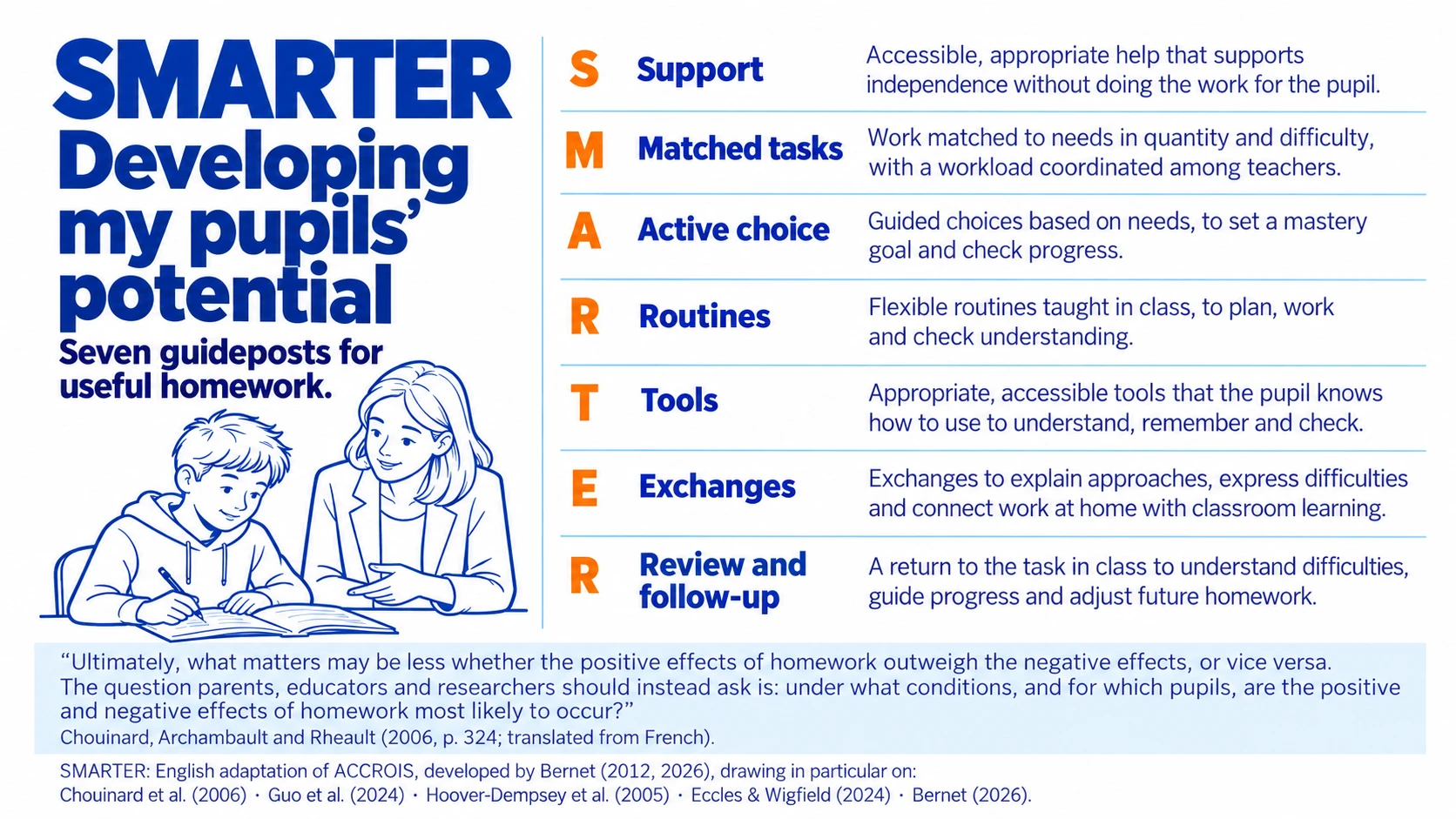
The pointers work together: routines and tools support the approach; assistance and choice support the pupil; calibration takes account of need and workload; interactions and follow-up enable adjustments.
For Léa, we could review the examples and how they are used. For Noé, we could adjust the revision method, then the amount of work or the deadline if demands accumulate. Re-examining homework therefore means identifying what is getting in the way before deciding what to change.
When several demands are involved, this analysis calls for collaboration.
Across the school: coordinate homework and review practice
To organise this collaboration, the volume Piloter proposes collective reflection (Carbonnier et al., 2024). School leaders can bring teachers together to consider a task’s objective, instructions, preparation and observed effects. What expectations lie behind ‘learn a lesson’?
To support this exchange, Classroom Hub’s internal discussions can be used; leaders can view content according to the permissions granted. The team remains responsible for adjustments.
Concretely, let us choose one task over one week. The teacher compares the approach prepared in class, the approach reported by the pupil and an answer produced on return. The team also examines the combined demands.
The next trial will then help establish whether the adjustment helps the pupil apply their knowledge more effectively. For Léa and Noé alike, the question becomes: what have we learnt about their work, and what should we change in our practice?
References
Bernet, E. (2026). The hidden cost of helpful habits. Singapore Psychologist, (24), 26–29. Article
Carbonnier, L., Caron, G., Decru, C., & Wantiez, O. (2024). Le travail personnel de l’élève : Tome 1, Piloter. Académie de Lille. Guide
Carbonnier, L., Caron, G., Decru, C., & Wantiez, O. (2025). Le travail personnel de l’élève : Tome 2, Accompagner. Académie de Lille. Guide
Chouinard, R., Archambault, J., & Rheault, A. (2006). Les devoirs, corvée inutile ou élément essentiel de la réussite scolaire ? Revue des sciences de l’éducation, 32(2), 307–324. https://doi.org/10.7202/014410ar
Eccles, J. S., & Wigfield, A. (2024). The development, testing, and refinement of Eccles, Wigfield, and colleagues’ situated expectancy-value model of achievement performance and choice. Educational Psychology Review, 36, Article 51. https://doi.org/10.1007/s10648-024-09888-9
Guo, L., Li, J., Xu, Z., Hu, X., Liu, C., Xing, X., Li, X., White, H., & Yang, K. (2024). The relationship between homework time and academic performance among K–12: A systematic review. Campbell Systematic Reviews, 20(3), e1431. https://doi.org/10.1002/cl2.1431
About the author
Emmanuel Bernet, Ph.D.
Teacher, researcher, trainer and international consultant
PhD in Educational Sciences, Educational Psychology (Université de Montréal)
Master’s in Training Practice and Engineering (Université de Bordeaux)

With 30 years’ experience in schools in Quebec and abroad, Emmanuel is a teacher, researcher, trainer and educational consultant. He supports school leaders and teaching teams in analysing their needs, developing their practices and carrying out their projects. His work connects scientific knowledge with the realities of educational practice, particularly in motivation, competency-based assessment, classroom management, educational technologies (including AI) and well-being at school for both pupils and teachers. He offers consultancy, training and ongoing support tailored to each school’s context. Would you like to arrange training for your team or support for your school? Contact the Eduka team to develop your project with Emmanuel Bernet.