































A grammar quiz, a maths worksheet, a short essay: each one tells you something useful. But on its own, each is a snapshot of one performance, in one situation, at one moment. Competency-based assessment asks a harder question: how do you string those snapshots together into a moving picture of a student’s development, one that teachers can read and students can learn from?
What a single result can’t tell you
In writing, a dictation tests spelling, a grammar exercise checks whether a student can use a tense, and a short composition shows how well they build sentences. Each of these results documents what researchers call the student’s internal resources: the knowledge, skills, strategies and attitudes they can draw on.
Maths works the same way. A student who gets their calculations right may still struggle to choose the right operation in an unfamiliar problem, set out the data and explain their reasoning.
Snapshots are useful for spotting a difficulty and targeting practice. The problem starts when a single result is treated as the full picture of a competency.
What is a competency? The French common core definition
France’s national common core of knowledge, skills and culture (the socle commun) offers a useful starting point. It defines a competency as the ability to draw on knowledge, skills and attitudes to carry out a task or handle a complex or unfamiliar situation (French Ministry of Education, 2015).
Tardif (2006) takes a similar view. He describes a competency as a complex ability to act, which depends on combining internal and external resources effectively across a family of related situations. He identifies five characteristics. A competency is:
- Integrative: it draws on many different kinds of resources.
- Combinatorial: it combines them differently depending on the task.
- Contextual: how it is used depends on the real-life situation.
- Developmental: it keeps developing throughout life.
- Evolving: it takes on new resources and situations without changing its nature.
Take writing. A student combines vocabulary, sentence structure, the organisation of ideas and a sense of who they are writing for. They might check a dictionary or a tablet, look at model texts or a rubric, or talk it over with a classmate. Being competent means choosing the right resources and combining them well, not using everything every time.
From exercises to complex tasks
Students build this ability by learning and practising each resource. In the first year of primary school, work on segmenting words or putting a sentence together can lead up to writing a message to another class. In lower secondary, studying linking words, gathering arguments and analysing texts can lead up to a written proposal for the student council.

A complex task brings all of this together without spelling out every step. The teacher looks at the finished piece and at how the student got there: why this argument, this example, this change? If something isn’t working, the student can go back to a targeted exercise, then use that skill in their writing again.
The same principle works in maths:
- In the last years of primary school, choosing books for a class reading corner on a fixed budget calls for researching, representing, reasoning, calculating and communicating.
- In the second year of lower secondary, planning a vegetable garden within limits on area, spacing and budget adds modelling to the mix.
What makes a task complex is the number of choices and connections involved, not the size of the project. The real test is transfer to a new but related situation. After presenting their proposal to the student council, for instance, a student might argue for a different option in a letter to parents.
To do that, they have to adapt their vocabulary, arguments and examples. But an authentic or cross-curricular setting won’t guarantee transfer on its own: teachers still need to observe what each student actually does, with which resources and how much help.
Documenting each student’s development over time
Observations only make sense when they are connected over time. In practice, a handful of pieces of work, each with its context noted, can show how a student is progressing:
- A first, guided draft.
- A revised version, with comments from the student, classmates and the teacher.
- A new piece of writing completed more independently.
This sequence is just an illustration: three good pieces of work don’t automatically prove that a student has moved up a level. Without knowing the tasks, the criteria and how much support was given, scores are hard to compare.
Making sense of this evidence requires reference points. A cognitive model of learning maps out the expected progression, the typical obstacles and the key learning milestones: lasting changes in how a student understands and acts. In writing, one such milestone might be moving from simply listing ideas to organising them with the reader in mind.
These reference points still need to be checked against how students actually progress. A lasting change doesn’t guarantee every later performance. A sound judgement relies on consistent evidence gathered across varied but comparable situations.
Descriptive rubrics and feedback: two tools for students
For these reference points to help students as well as teachers, students need to understand them. The assessment tools described by Durand and Chouinard (2012) don’t all give the same kind of information:
| Response format | Types and forms | Effectiveness according to the authors* |
|---|---|---|
Binary Yes / no | Dichotomous scale Checks whether an element is present or absent using two response options. Mainly used in a checklist. | Limited |
Graded Continuum | Rating scales The same response options are used across all criteria in a rating, assessment or observation grid. Quantitative — graphic · numerical · pictorial · alphabetical Qualitative — levels expressed in words | Effective |
Descriptive rubrics Levels of quality are described in a rating, assessment or observation grid. Analytic rubric — descriptions for each criterion and level Holistic rubric — an overall description for each level | Highly effective |
Binary — Yes / no
Dichotomous scale
Checks whether an element is present or absent using two response options.
Mainly used in a checklist.
Effectiveness according to the authors*: Limited
Graded — Continuum
Rating scales
The same response options are used across all criteria in a rating, assessment or observation grid.
Quantitative — graphic · numerical · pictorial · alphabetical
Qualitative — levels expressed in words
Effectiveness according to the authors*: Effective
Descriptive rubrics
Levels of quality are described in a rating, assessment or observation grid.
Analytic rubric — descriptions for each criterion and level
Holistic rubric — an overall description for each level
Effectiveness according to the authors*: Highly effective
* For making assessment judgements, within the typology presented in the book.
Adapted from Durand and Chouinard (Eds.), 2012, pp. 268 and 272–276.

A rubric can be designed for a single task or reused across several.
In writing, the choice of rubric changes the feedback it can give. Counting linking words says little about whether a text hangs together. A better descriptor might read: “I explain how my example supports my argument.”
Before and while writing, students can use it to pick out a passage, explain where they think they stand, and decide what to improve. The next level up on the rubric shows them what to work on, in the current task or a similar one. This kind of self-assessment only works when students understand the criteria, see examples and get support that is gradually withdrawn, as discussed in the review by Kaboré et al. (2022).
Feedback builds on this. It can answer the three questions identified by Hattie and Timperley (2007):
- Where am I going?
- How am I going?
- Where to next?
Example feedback
“Your argument is clear. Now explain how your example supports it, then reread your paragraph with that in mind.”
Feedback like this focuses on the task, the strategy or the student’s self-regulation. What makes it valuable is that it gives the student something they can act on, and the meta-analysis by Wisniewski et al. (2020) shows how much that matters.
Competency-based assessment: from portfolio to report card
Feedback supports learning day to day, for example in a portfolio. The report card then sums up how each competency has developed, based on the evidence collected. It can show what the student has achieved, how independent they have become and what comes next:
Example report comment
“In their recent writing, the student states a clear point of view and backs it up with arguments. They use the rubric to structure their paragraphs. The next step is to show more clearly how their examples support their arguments.”
To back up a summary like this, the teaching team needs shared criteria, reasonably comparable tasks and regular discussion of real student work. There is no need to keep everything: each piece of evidence should shed light on progress, a difficulty or a teaching decision.
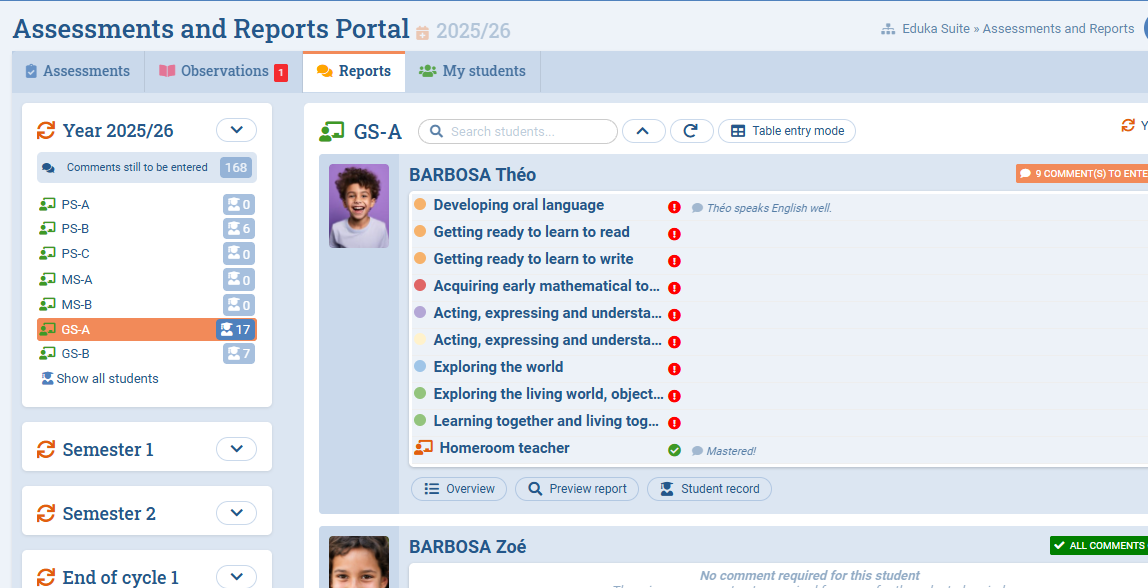
Digital tools can make all this easier to organise. Eduka’s Assessments and Reports module lets schools manage assessments, write report comments and produce report cards. But a tool is only as useful as the shared approach behind it: connecting observations, documenting each student’s progress and making the next step clear. That is how everyday snapshots add up to a real picture of development.
References
- Durand, M.-J., & Chouinard, R. (Eds.). (2012). L’évaluation des apprentissages : De la planification de la démarche à la communication des résultats [Assessment of learning: From planning the process to communicating the results] (Rev. and expanded ed.). Éditions Marcel Didier.
- Hattie, J., & Timperley, H. (2007). The power of feedback. Review of Educational Research, 77(1), 81–112. https://doi.org/10.3102/003465430298487
- Kaboré, N. D., Frenette, É., & Hébert, M.-H. (2022). Revue systématique sur les pratiques évaluatives probantes en évaluation formative à l’enseignement primaire et secondaire [A systematic review of evidence-based formative assessment practices in primary and secondary education]. Revue des sciences de l’éducation, 48(1). https://doi.org/10.7202/1096356ar
- Ministère de l’Éducation nationale. (2015). Socle commun de connaissances, de compétences et de culture [Common core of knowledge, skills and culture]. Bulletin officiel, 17. https://www.education.gouv.fr/bo/15/Hebdo17/MENE1506516D.htm
- Tardif, J. (2006). L’évaluation des compétences : Documenter le parcours de développement [Assessing competencies: Documenting the developmental pathway]. Chenelière Éducation.
- Wisniewski, B., Zierer, K., & Hattie, J. (2020). The power of feedback revisited: A meta-analysis of educational feedback research. Frontiers in Psychology, 10, Article 3087. https://doi.org/10.3389/fpsyg.2019.03087
About the author
Emmanuel Bernet, Ph.D.
Teacher, researcher, trainer and international consultant
PhD in Educational Sciences, Educational Psychology (Université de Montréal)
Master’s in Training Practice and Engineering (Université de Bordeaux)

With 30 years of experience in schools, in Quebec and abroad, he supports school teams with competency-based assessment and the quality of feedback, through evidence-based approaches adapted to their context. For example, he runs workshops on building descriptive rating scales and on the collective analysis of student work, using artificial intelligence. Shared tracking of observations and teaching decisions helps teams adjust their practice and follow their progress.