






















“With AI, we could build it ourselves.” The idea is spreading through more and more leadership teams. It is appealing, and it is wrong.
Building your own school management software, even with the help of artificial intelligence, costs more, exposes your institution further and lasts less long than a proven solution. This is not an opinion: it is what we see, year after year, in the schools that join Eduka after trying to go it alone. We have brought these findings together in a white paper.
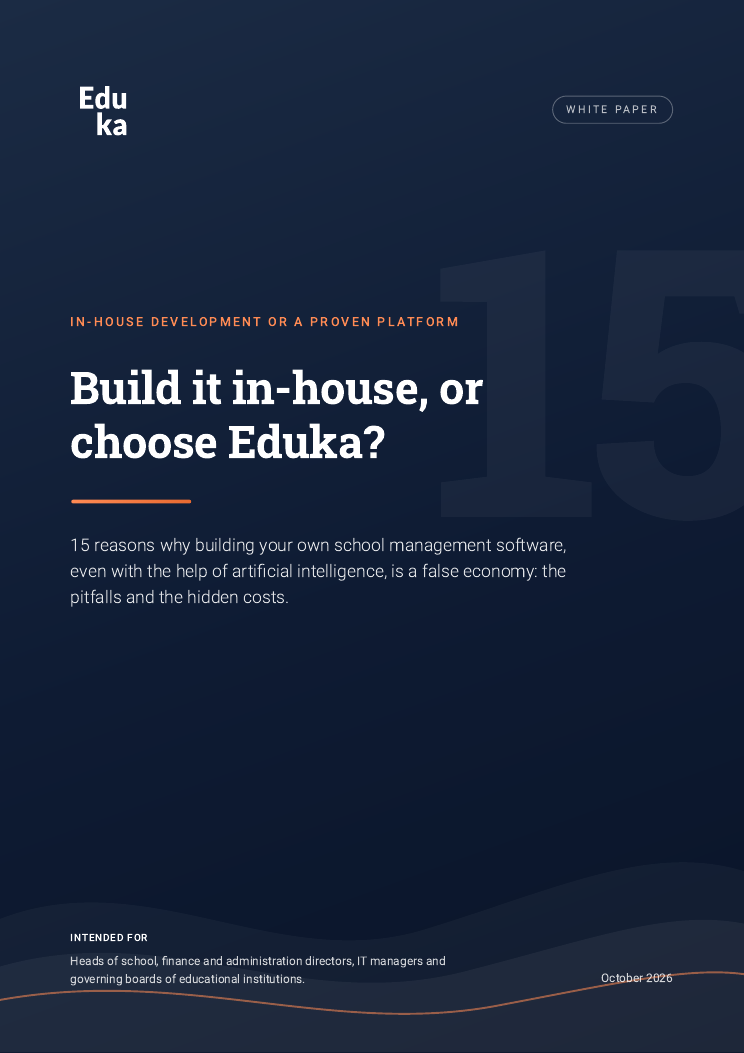
Free white paper · 13 pages
Build it in-house, or choose Eduka? 15 reasons not to develop your own
All 15 reasons explained one by one, an item-by-item full-cost grid, and six questions to ask your team before deciding. A fifteen-minute read, ready to share with your governing board.
Code was never the real cost
AI produces a working student management screen in two hours. Management concludes the project is 80% done. It is 5% done. What is missing never shows up in a demo: access rights by profile, migration of past records, performance on the evening school reports are published, backups that can actually be restored, compliance, support, service continuity. The finishing touches are not the end of the project: they are the project.
AI excels at producing plausible code. School management software does not need to be plausible: it needs to be exact on 30 June at 5 pm.
Three numbers to remember
5%
The real progress of a project believed to be 80% complete after a successful demo.
100%
The share of the costs you fund alone in-house, compared with a pooled fraction with a vendor.
0
The number of parties you can hold liable if an incident occurs on an in-house tool.
15 reasons, four hard truths
The savings are an illusion
- You pay 1/N, not 100%. With a vendor, development, security and regulatory monitoring are shared across every institution. In-house, you fund everything alone, and nothing ever comes to you from outside.
- “Free” software costs a salary. Every year, with no end date. The right comparison is not a licence versus zero, but a licence versus the payroll devoted to the tool.
- The demo is not the software. The prototype is a fraction of the work; everything else only reveals itself in production, in front of families.
The risk stays entirely with you
- Security becomes your responsibility. With no audit, no penetration test and no monitoring, a leak of minors’ data puts the leadership team directly in front of the families.
- No one to transfer the legal risk to. A vendor signs a data processing agreement under Article 28 of the GDPR and takes on liability. Your in-house team does not.
- Compliance is a full-time job. GDPR, PDPA, PDPL: record of processing activities, impact assessment, breach notification within 72 hours, families’ rights. The rules change, and the tool has to keep up.
Operations depend on one or two people
- The day the developer leaves, the tool dies. That is the story of a significant share of the schools that join Eduka.
- You are creating a support desk for life. On go-live day, your developer becomes the helpdesk for hundreds of families and teachers.
- No one is on call. Start of term, school reports, admissions: the school calendar is not negotiable, and it does not stop while your developer is on holiday.
- Hosting is the forgotten line. Servers, backups, monitoring, audits: a recurring bill that nobody budgeted for.
- Every integration eventually breaks. Payments, accounting, single sign-on: every connector is a project, and each one fails silently the day the remote service changes.
- An in-house tool will never be all-in-one. The result: tools to synchronise, data that drifts apart, and parents juggling several passwords.
Over time, the asset becomes a liability
- The exit trap. Extracting ten years of history from an undocumented system often costs more than the original project. With Eduka, reversibility is written into the contract.
- An irreversible commitment disguised as a saving. An in-house tool cannot be sold, audited or valued. A licence is a predictable expense, and a terminable one.
- It is not your core business. You do not develop your own payroll or accounting software. School management software combines both, plus minors’ data and a non-negotiable calendar.
Six questions to ask your team before deciding
Decision-makers remember questions better than arguments. Ask these, and listen to how they are answered.
- Who fixes the tool at 7 am on 2 September if the timetables do not display?
- When was the last restore test of the backups? Not the backup: the restore.
- Can you produce, today, the record of processing activities and the impact assessment for the tool?
- A parent exercises their right of access or erasure: how long does it take to respond, and who handles it?
- Who audited the code, when, and where is the report?
- If your developer resigns tomorrow morning, how many weeks before a replacement is self-sufficient on their code?
If even one answer is hesitant, the in-house project is already in debt, before it has even begun.
Before you decide, compare
AI has made the first step of software development spectacularly fast. It has changed nothing about the rest: security, compliance, support, service continuity, maintenance and exit. Before committing your institution, compare the full cost of both options, item by item. The white paper contains the grid to do it; the Eduka team can fill it in with you, for your own scope.