
























By Emmanuel Bernet, Ph.D.
Writing for a reader is a competency.
In this article, internal resources refer to the student’s knowledge, strategies, attitudes, and habits; external resources refer to the tools, documents, benchmarks, feedback, and support available. Students mobilize and combine these resources to act within a family of situations: situations with a similar purpose that call for comparable combinations of resources.
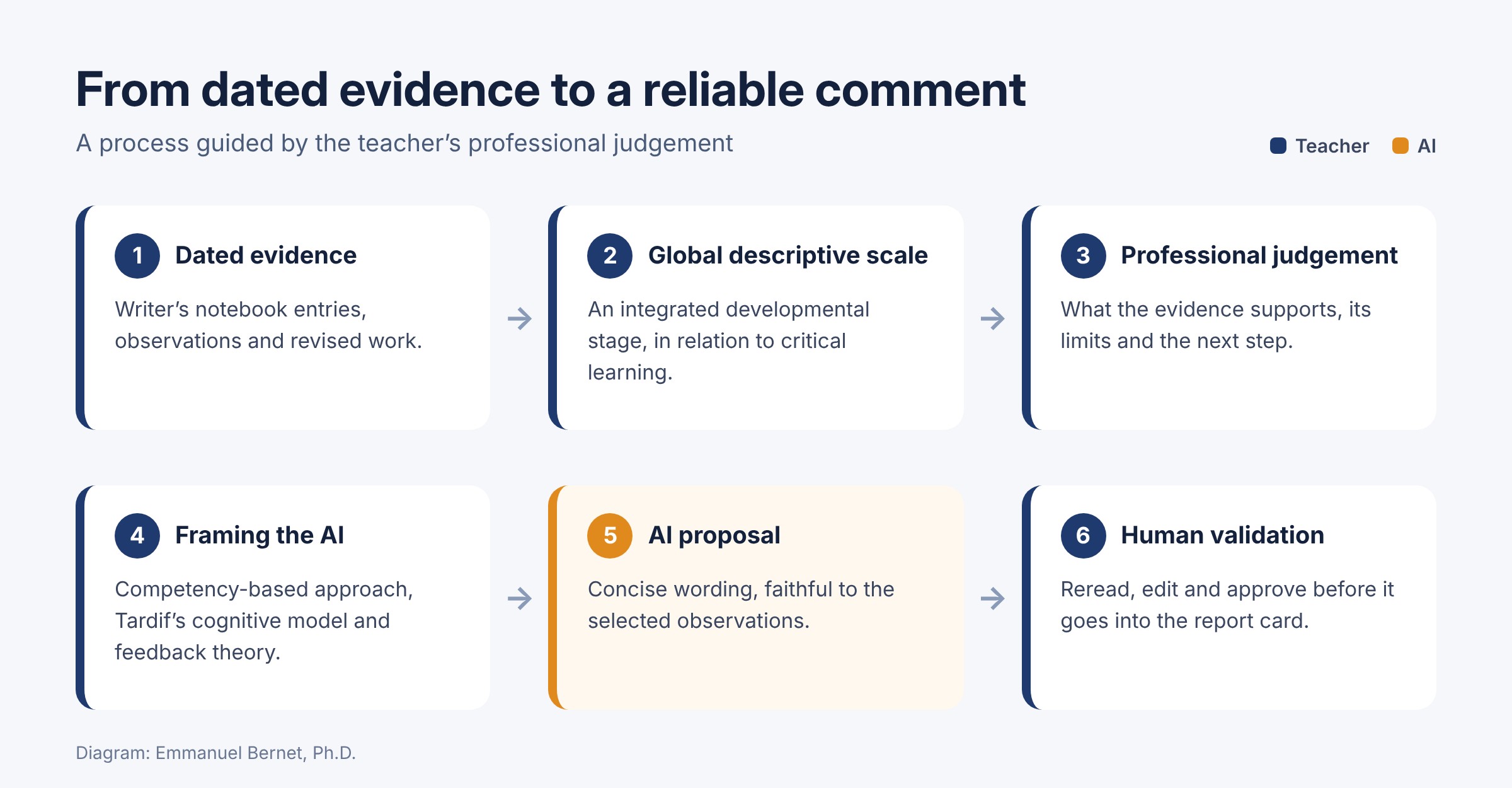
For a fourth grader, recounting a personal experience, inventing a story, or writing for a reader all draw on this competency. When preparing report cards, a teacher rereads three dated entries from one student’s writer’s notebook. In September, the student recounts an everyday experience in short, disconnected sentences. In October, the student writes a story using vocabulary taught in class, based on a plan built together with the teacher. In November, the student organizes a coherent narrative independently.
The sequence suggests growth. But what can it legitimately tell us about the student’s writing competency? AI can draft a report card comment in seconds, but the teacher decides what the evidence supports: the resources the student drew on, the level of support needed, the developmental stage, and the next step. Let’s follow this fictional example.
Assessing a competency on report cards, not isolated skills

For Tardif (2006), a competency is a complex capacity for action that mobilizes and combines resources within a family of situations. Writing therefore involves organizing ideas, adapting a text to a reader, choosing examples, rereading, and revising.
In Tardif’s cognitive model, a developmental pathway is not a stack of isolated knowledge. It makes critical learning explicit: the transformations a student needs to move through the stages of a competency. In writing, this might mean moving from short, disconnected sentences to an organized narrative that draws on the vocabulary and grammar taught in class.
This model guides professional judgment. An analytic rubric scores organization, vocabulary, spelling, or use of examples separately. A holistic rubric, by contrast, describes an integrated developmental stage in relation to critical learning. It doesn’t add up or average those dimensions; it helps the teacher interpret how the student combines them in a writing task. Durand and Chouinard (2012) show how tools like these support teacher judgment.
Grade-level standards show the destination; they don’t necessarily describe the route. Descriptors such as “organizes with support” or “independently organizes a narrative and reuses classroom resources” correspond to possible stages. They still need to be developed and validated for this writing competency and the tasks involved. A checklist that only counts transition words or agreement errors can’t describe this kind of development.
The writer’s notebook: dated evidence behind every comment
Weekly entries in a writer’s notebook offer a longitudinal view: they make growth visible over time. But the sequence alone doesn’t prove progress. In October, the story relied on a scaffolded plan; in November, the student organized a new story without one.
The writer’s notebook is a well-established practice, widely used in writing workshops. It gives students a regular space to recount, imagine, and experiment. They reuse the vocabulary, grammar, spelling, and sentence structures taught in class, then reread and revise their work.
In our example, the teacher might note: “November: personal narrative; no plan provided; clear sequence of events; vocabulary from the lesson reused; subject-verb agreement still inconsistent.” This evidence makes it possible to place the student at a provisional stage on the holistic rubric. The notebook also lets the student look back at earlier entries, so the comparison rests on a dated record.
AI and student data: what to check first
Before sharing any information with an AI tool, teachers need to check the rules that govern student data. Using a pseudonym doesn’t necessarily make records anonymous. In France, the CNIL (the national data protection authority) recommends involving school leadership and the data protection officer, and the Ministry of Education’s AI framework advises against consumer AI tools whenever personal or confidential data are involved. The school sets the authorized framework; the teacher chooses the evidence and takes responsibility for the judgment shared.
What a report card comment should help families understand
Using this evidence and the rubric, the teacher forms a judgment. Here, the teacher may recognize progress in organizing narratives independently and in reusing taught vocabulary. A difficulty also remains: the student still needs to check subject-verb agreement and make the sequence of events clearer. These observations don’t support a claim of overall mastery in narrative writing.
How does this judgment become a useful comment? Hattie and Timperley (2007) offer three questions for thinking about feedback: Where am I going? How am I going? Where to next? A report card comment answers them for the student and their family: it shows which internal and external resources the student draws on and combines in the task, places their progress on the holistic rubric, and points to a next step.
Writing report card comments with AI, then verifying them

Once the content is decided, the teacher can set up an assistant with the selected observations, the relevant benchmarks, the judgment reached, and the writing constraints. This setup is not technical model training. The request is for wording that is concise, clear, and faithful, without adding progress, intentions, diagnoses, or judgments that the evidence doesn’t support.
This boundary matters even with detailed instructions. Bogolepova’s (2025) review of AI-assisted text assessment and feedback found, among other things, that AI suggestions can be generic, repetitive, or poorly suited to the context. It underlines the importance of teacher mediation. These findings don’t prove that an assistant works for report cards; they clarify what teachers need to check.
Example: AI draft vs. final comment
| Fictional AI draft | Final comment after verification |
| “The student has now mastered narrative writing and always uses grammar rules correctly.” | “In the writer’s notebook, the student now organizes stories more clearly and reuses vocabulary taught in class. To help readers follow the story, the student still needs to use transition words and check subject-verb agreement.” |
The second version limits its claims to the work observed and keeps a learning goal in view. Before keeping it, the teacher can ask three questions:
- Is every claim backed by evidence?
- Does it account for the support the student received and the limits of what was observed?
- Will the student understand what to try next?
The teacher keeps, edits, or rejects the text. A well-turned sentence never replaces that decision. If the observations aren’t enough, the comment should be narrowed or new evidence gathered. Asking AI to make the text sound more confident doesn’t fill that gap.
Preparing report card comments with Eduka
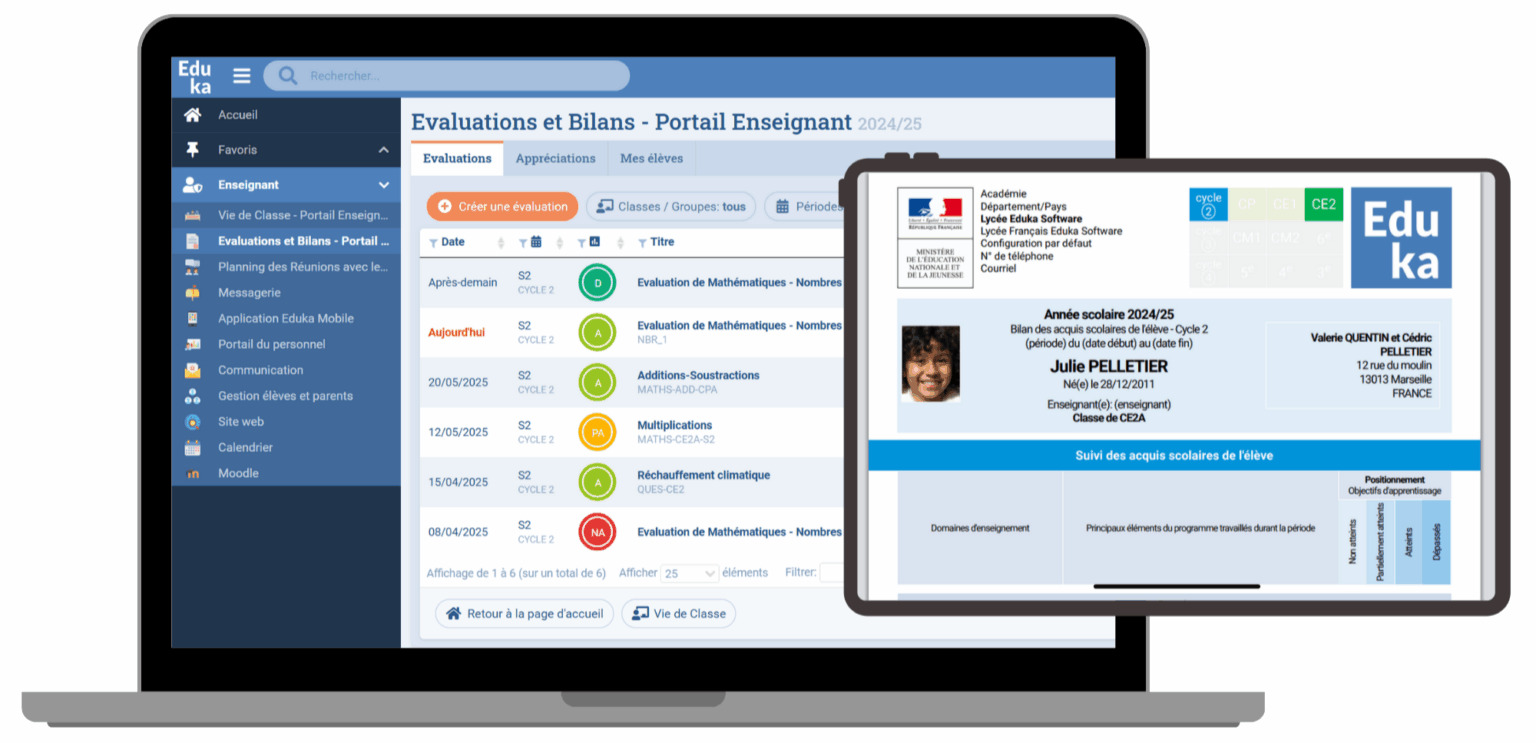
This approach depends on shared benchmarks. Eduka’s Assessments & Reports module lets teams set up competencies and rubrics, consolidate results, and prepare report cards; its official page also announces AI assistance for drafting comments. The Documents module supports document and template management.
In a later writer’s notebook session, the teacher revisits the report card goal with the student: linking events with transition words and checking subject-verb agreement. So before turning to AI, the teacher can ask whether the comment rests on evidence, reflects the support the student needed, and sets a goal that will actually be revisited. That is what makes a report card comment part of the learning pathway.
References
Bogolepova, S. V. (2025). Potential of artificial intelligence tools for text evaluation and feedback provision. Professional Discourse & Communication, 7(1), 70–88. https://doi.org/10.24833/2687-0126-2025-7-1-70-88
Commission nationale de l’informatique et des libertés. (2025, June 20). Enseignant : comment utiliser un système d’IA dans le cadre de vos missions ? [Teachers: How to use an AI system in your work]. https://www.cnil.fr/fr/enseignant-usage-systeme-ia
Durand, M.-J., & Chouinard, R. (Eds.). (2012). L’évaluation des apprentissages : de la planification de la démarche à la communication des résultats (Rev. ed.). Éditions Marcel Didier.
Hattie, J., & Timperley, H. (2007). The power of feedback. Review of Educational Research, 77(1), 81–112. https://doi.org/10.3102/003465430298487
Ministère de l’Éducation nationale et de la Jeunesse. (2025). L’IA en éducation – Cadre d’usage [AI in education: Framework for use]. https://www.education.gouv.fr/publication-du-cadre-d-usage-de-l-intelligence-artificielle-en-education-450652
Tardif, J. (2006). L’évaluation des compétences : documenter le parcours de développement. Chenelière Éducation.
About the author
Emmanuel Bernet, Ph.D.
Teacher, researcher, trainer and international consultant
PhD in Educational Sciences, Educational Psychology (Université de Montréal)
Master’s in Training Practice and Engineering (Université de Bordeaux)

With 30 years’ experience in schools in Quebec and abroad, Emmanuel is a teacher, researcher, trainer and educational consultant. He supports school leaders and teaching teams in analysing their needs, developing their practices and carrying out their projects. His work connects scientific knowledge with the realities of educational practice, particularly in motivation, competency-based assessment, classroom management, educational technologies (including AI) and well-being at school for both pupils and teachers. He offers consultancy, training and ongoing support tailored to each school’s context. Would you like to arrange training for your team or support for your school? Contact the Eduka team to develop your project with Emmanuel Bernet.