






















More and more schools are taking on a role beyond educating their students: they are also becoming exam centres. A French school abroad may organise Baccalauréat and DNB exams, while an international school may host Cambridge (IGCSE, A-Level) sessions or the International Baccalaureate (IB). Other schools may offer DELF/DALF, SAT or language certification exams.
While this role can be valuable for a school, it also creates significant administrative demands. Student admissions, exam schedules, room bookings, seating plans, invigilator management, special arrangements, exam paper confidentiality, communication with families and awarding organisations, and the entry and distribution of results: each exam session involves multiple teams over several weeks.
Many schools still manage these processes using spreadsheets, emails and paper documents. Yet this is precisely the type of information that a SIS, MIS or school ERP can centralise. So how can school management software make running an exam centre easier?
SIS, MIS & School ERP: What Do These Terms Mean?
These three terms are commonly used when discussing school management software, but they can sometimes be confusing.
A SIS (Student Information System) focuses primarily on student data: records, enrolment, grades, attendance, timetables and reports.
A MIS (Management Information System), a term particularly common in the UK and within the Cambridge school network, broadly covers the same areas, with a greater emphasis on reporting and management information.
A school ERP (Enterprise Resource Planning) goes further by connecting student data with other school processes — admissions, finance, school services, communications, documents and reporting.
This distinction matters when managing an exam centre. An exam session is not just an academic activity: it is a cross-functional process involving administration, logistics, finance (for external candidates), communications and compliance. This is why an ERP approach can often provide the most complete solution.
The Specific Challenges of Running an Exam Centre
Organising an exam session involves requirements that go beyond day-to-day school administration.
- First, schools need to ensure accurate candidate registration: identifying candidates, distinguishing enrolled students from external candidates, checking subject combinations and meeting deadlines set by awarding organisations such as Cambridge, IB, ministries and France Éducation international.
- They must then organise the logistics: booking rooms, creating candidate seating plans, assigning invigilators, preparing equipment and managing multiple exams running at the same time without timetable or room conflicts.
- They also need to manage special arrangements: additional time, separate rooms and other approved accommodations must be documented, validated and incorporated into the exam schedule.
- Finally, there is confidentiality (strictly controlled access to exam papers and results), communication (exam confirmations, instructions and dates for candidates and families) and results management (entering results, producing transcripts, certificates and performance statistics).
When managed manually, this entire process creates unnecessary duplication, increases the risk of errors and adds pressure as exam sessions approach.
What School Management Software Can Do for an Exam Centre

Centralised, reliable registration: Instead of rebuilding candidate lists in spreadsheets, school management software allows schools to work from data already stored in the system. Each candidate has a single record linked to their subjects, year group and administrative information.
For external candidates, an admissions module or online registration form can feed directly into the database, eliminating duplicate data entry. The information can then be used to generate the official lists required by the awarding organisation.
Conflict-free scheduling and room management: By using timetables and resource management tools, the platform helps schools schedule exams, book rooms and prevent clashes. Candidate seating plans and invigilator assignments become structured processes rather than last-minute headaches.
Managing special arrangements: Additional requirements, such as extra time, medical arrangements or dedicated rooms, can be recorded in a student’s profile alongside supporting documents and then incorporated into the exam schedule. The right information reaches the right people at the right time, without relying on one person’s memory.
Billing external candidates: When an exam centre accepts external candidates, it may need to charge registration fees. A school ERP connects this financial process to the rest of the workflow: an approved registration can trigger an invoice, online payments can be tracked and reconciled automatically, and school leaders have a clear view of expected and received payments. This removes the need to manage exam finances in a separate system.
Communicating with families and candidates: Exam confirmations, instructions, dates, room information and results can all be shared from the platform through the parent portal or targeted communications. Families have a single point of access, while schools can reduce the number of emails and calls generated by each exam session.
Results, transcripts and certificates: After exams, assessments and results can be entered, consolidated and used to produce transcripts or certificates. Performance statistics can also support school management and reports shared with awarding organisations or the governing board.
Security, Compliance and Audit Trails
An exam centre handles particularly sensitive data, including candidate identities, medical arrangements, exam papers and results. Security is therefore essential.
Effective school management software should provide role-based access controls, granular permissions, activity tracking and login logs. Only authorised users should be able to access exam papers or results, with every action recorded.
This level of control helps meet the requirements of awarding organisations as well as data protection obligations such as the GDPR in Europe. For international schools, it also helps build trust with families and school leadership.
SIS, MIS or ERP: Which Is Best for an Exam Centre?
The right choice depends on the scope of your requirements. If a school mainly needs to manage student records, grades and academic results, a SIS/MIS may be sufficient for the academic side of exam management.
However, when an exam centre also needs to manage external candidate registration, billing, room logistics, communications and end-to-end compliance, an ERP approach becomes more relevant. This is particularly true for international schools managing multiple examination frameworks, languages and, in some cases, multiple campuses.
The goal is not simply to have a system for entering grades. It is to connect people, data and processes throughout every stage of an exam session.
Eduka: School Management Software for International Schools
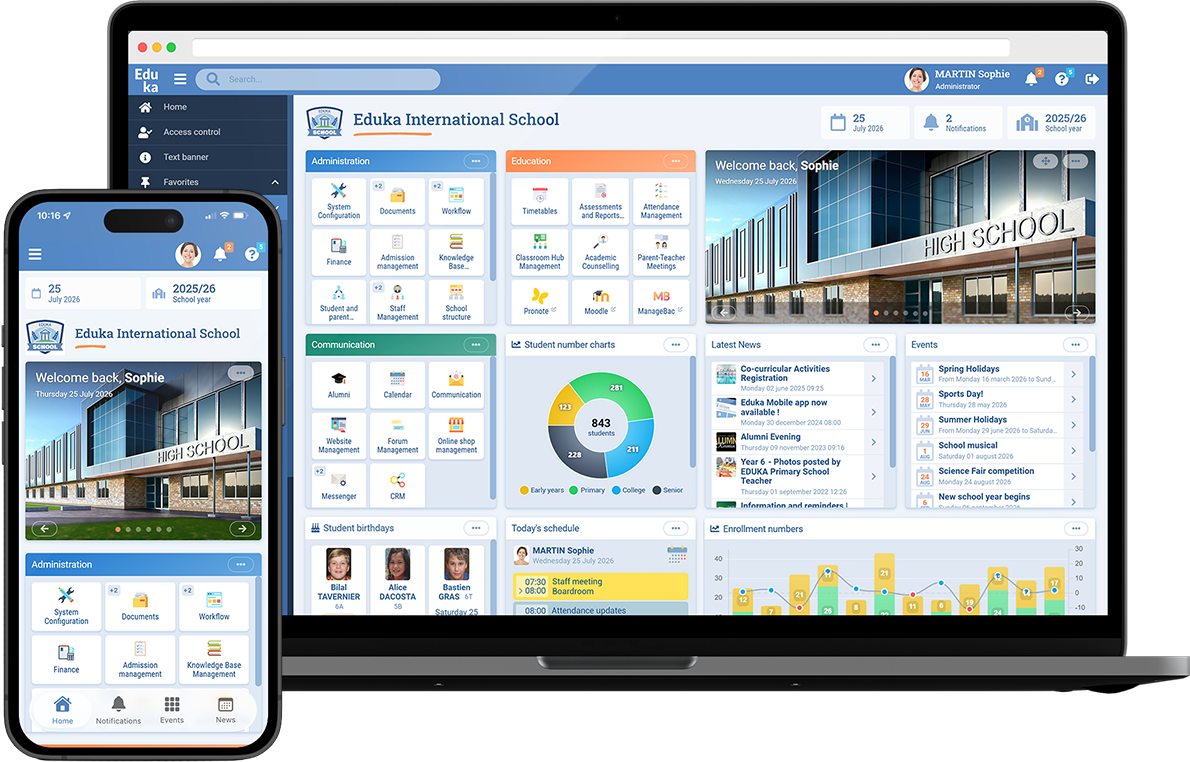
Eduka supports international schools with a modular school management suite covering administrative, financial, academic and operational needs — from candidate admissions and billing to timetables, assessments, communications and document management.
For schools that also operate as exam centres, this approach makes it possible to manage each exam session as one connected process rather than a series of isolated tasks. The same data can be used throughout the process, teams work from a shared system, and school leaders maintain a clear overview of the entire operation.
School management software is therefore more than a place to store information: it helps schools run exam sessions with greater efficiency, security and confidence.