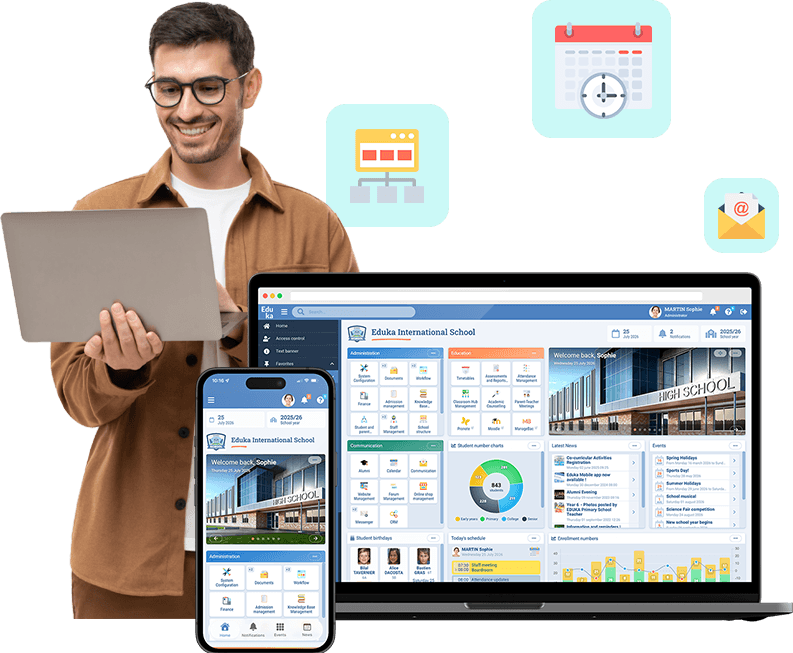






























Implementing a school MIS / SIS is a transformative decision for an educational institution. It is not merely a matter of installing new software, but of rethinking how data, teams, and processes flow within the school.
For an international school, the stakes are even higher. Staff often have to manage multiple languages, multiple nationalities, and sometimes multiple currencies, as well as a variety of after-school programs, specific administrative rules, and high expectations from families.
A well-implemented school ERP system can simplify day-to-day operations for staff, centralize information, improve the reliability of financial management, and enhance the parent experience. Conversely, a poorly planned project can create confusion, slow down adoption, and increase internal resistance.
Here are the 5 essential steps for successfully implementing a school MIS / SIS at an international school.
1. Clarify the project objectives
Before discussing modules, migration, or training, it is essential to determine why the school wants to implement an ERP system.
Goals can vary greatly from one school to another. Some want to reduce their reliance on Excel files. Others are looking to better integrate admissions and billing. Some want to improve communication with parents, ensure the reliability of student data, or strengthen management oversight.
This step is essential because it helps you avoid trying to do everything at once.
A good project starts with a few simple questions:
- Which school management problems do we want to address first?
- Which school processes are currently taking too long?
- Where do school management errors or duplicate entries occur?
- Which school services should be connected first?
- What results do we want the school to benefit from in the first few months?
For example, an institution may decide to start with student management, admissions, and finance, and then gradually add services, absences, schedules, assessments, or communication.
The goal isn’t to implement everything on day one. The goal is to develop a realistic plan that the teams can understand and that aligns with the school’s priorities.
2. Engage the right stakeholders
A school MIS/SIS system rarely involves just one department. It affects administration, finance, admissions, teachers, school leadership, department heads, the IT team, parents, and sometimes students. That is why the project should not be led solely by one person or a single department.
Each profile will have different expectations:

Management will seek a comprehensive overview of the institution. The finance teams will want to ensure the reliability of billing and payments. The admissions office will need to track applications more easily. Teachers will want a simple tool for their daily tasks. Parents will expect a clear and seamless experience.
Involving the right stakeholders from the start helps to better understand actual needs, anticipate potential issues, and encourage adoption.
It is helpful to form a small project team with representatives from the departments most affected. This team can help validate priorities, test workflows, share information, and provide support to users after the launch.
For an international school, this step is particularly important, as processes often cut across departments. An admission decision can have financial implications. Signing up for an activity may result in a billing charge. An absence can affect teachers, parents, and after-school programs.
A school MIS/SIS system works well when teams understand that they are not working in a fragmented way, but as a part of a single ecosystem.
3. Prepare and ensure the reliability of the data
Data quality is one of the most important factors in the success of an MIS/SIS implementation. Even the best software cannot produce good results if the source data is incomplete, inconsistent, or scattered.
Before the migration, the school must identify the information to be transferred:
- students;
- parents;
- legal representatives;
- classes;
- levels;
- users;
- costs;
- sales;
- financial records;
- documents;
- service registrations;
- useful academic data.
This step also provides an opportunity to clean up existing data. You need to identify duplicates, correct incomplete fields, standardize formats, and decide which data should be migrated, archived, or excluded.
Not all historical data needs to be migrated to the new MIS/SIS system. Some data can be stored in an archive, while active data must be prepared with greater precision.
For an international school, this work is even more important when families are multilingual, when administrative information varies by country, or when financial data must be retained for legal reasons.
A well-planned migration reduces errors, speeds up deployment, and builds user confidence in the new platform.
4. Roll out modules gradually based on priority
One of the most common mistakes in an MIS/SIS project is trying to roll out everything at once. A school management information system can cover many areas: admissions, students, finance, payments, services, communication, documents, absences, schedules, assessments, or reporting. But that doesn’t mean all these modules have to be launched simultaneously.
A phased rollout is often more effective. It allows you to focus your efforts on priorities, train teams in stages, and minimize operational overload.

For example, a school might start by:
- the parent portal
- student and family management;
- admissions;
- finance;
- payments;
Next, add:
- services such as activities, the cafeteria, or transportation;
- absences;
- schedules;
- the reviews;
- advanced communication;
- the documents ;
- internal workflows.
This approach makes it possible to achieve visible results quickly. Teams can clearly see the benefits of the new tool, which makes it easier for them to embrace the next steps.
For an international school, a phased rollout is particularly appropriate. It allows the pace of implementation to be aligned with school calendars, enrollment periods, financial deadlines, and staff availability.
The right scope to start with isn’t necessarily the broadest one. It’s the one that addresses the most important priorities while remaining realistic for users.
5. Train, communicate and support adoption
Simply launching a school MIS/SIS system is not enough. Success depends above all on user adoption.
Teams need to understand not only how to use the platform, but also why certain processes are changing.
Training must be tailored to each individual’s profile.
Administrative teams have different needs than teachers. The finance department does not follow the same workflows as the admissions office. Management does not require the same level of detail as operational users.
It is therefore best to organize targeted training sessions with specialists from each division:
- administration ;
- admissions ;
- finance ;
- teachers;
- department heads;
- management;
- internal support.
Communication with parents is also essential if the project includes a parent portal, online payments, service sign-ups, or digital documents.
Finally, support must continue after the launch. A school MIS/SIS system only becomes truly useful once it is understood, adopted, and integrated into the school’s daily routines.
Eduka: A phased rollout tailored to international schools
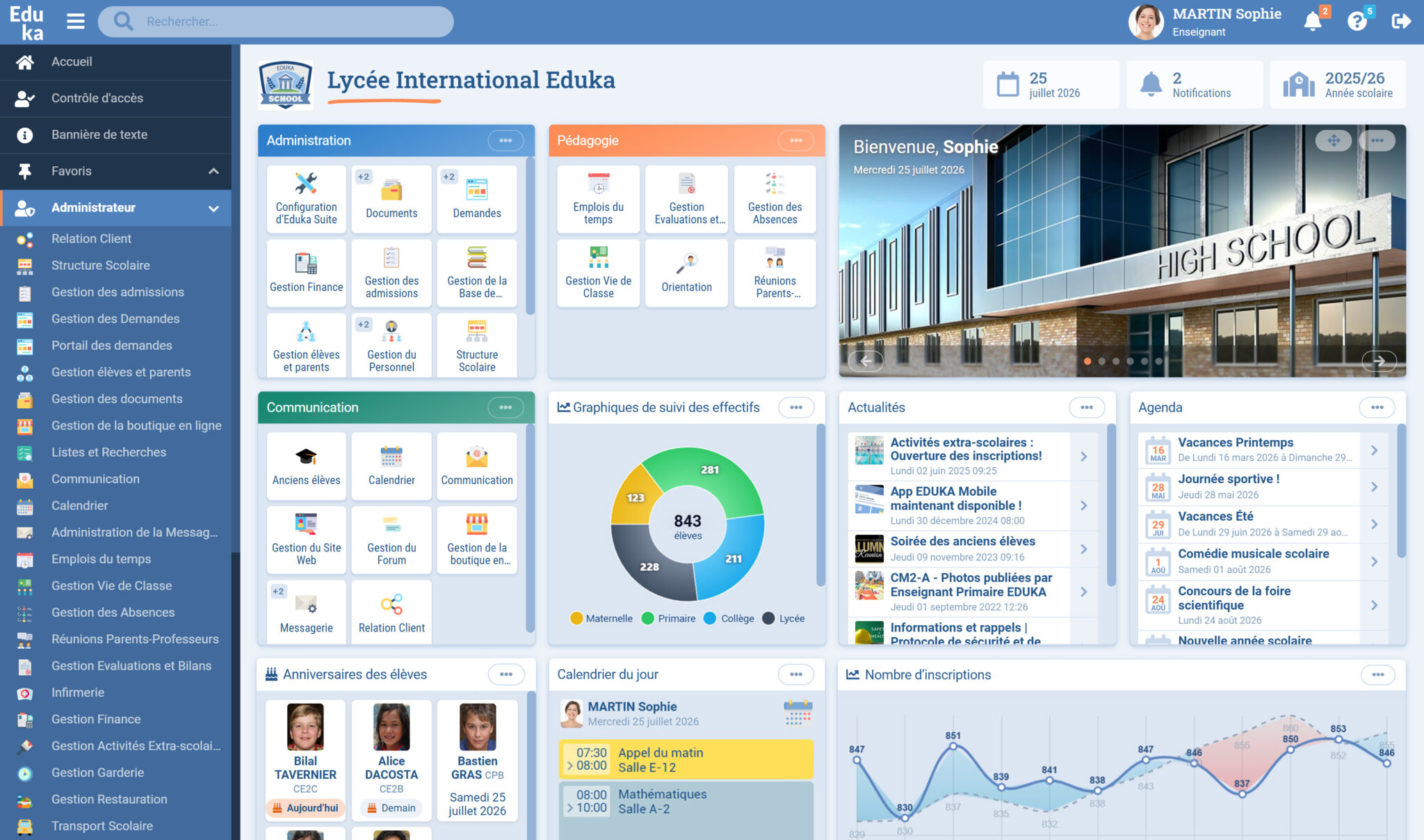
Eduka supports international schools in the phased implementation of their management platform.
Its modular approach allows each institution to start with its top priorities and then gradually expand its use of the solution.
For example, a school might start with admissions, student management, and financial management, and then add services, absences, schedules, assessments, communication, or documents.
This gradual approach allows us to keep pace with the teams, minimize disruptions to the organization, and encourage adoption.
Conclusion
Implementing a school MIS/SIS is a transformative project for a school.
To succeed, it’s not enough to simply choose a good solution. You also need to clarify objectives, involve the right stakeholders, prepare the data, define a realistic scope, and provide ongoing support to users. For an international school, these steps are even more critical. The more complex the environment, the more the project’s scope determines the success of the rollout.
A well-implemented school MIS/SIS can be a powerful tool for boosting efficiency, reliability, and service quality across the entire school!
What do you think?
This article is open for discussion in the Eduka Community. Ask your questions and share your experience with other schools.