





























In the education sector, several terms are often used to refer to school management software: SIS, school ERP, school management software, school management software, or school management platform.
These concepts are similar, but they do not always refer to the same thing.
For an international school, it is important to clearly understand the difference between a SIS and an educational ERP. Choosing a platform is not just about managing students or grades. It also involves admissions, billing, payments, extracurricular services, communication with families, data compliance, and the overall management of the school.
So, what’s the difference between a SIS and a school ERP system? And how can you determine which solution is best suited for your school?
What is a school SIS?
A SIS, which stands for Student Information System, can be translated into simple English terms as a student data management system.
This software is primarily focused on information related to students and their academic progress. Its purpose is to centralize, organize, and make essential academic data accessible.

A SIS typically includes features such as:
- certain academic or administrative reports.
- student files;
- registration;
- families’ administrative information;
- attendance and absences;
- grades or evaluations;
- report cards;
- schedules;
- parent contacts;
- certain academic or administrative reports.
In short, a SIS primarily solves one dilemma:
“How can we properly manage academic and administrative information related to students?”
For many schools, this is a key component. It helps organize student data, ensure the accuracy of information, and facilitate academic tracking.
But in an international school, the needs often go beyond that scope.
What is a school ERP system?
A school ERP, or ERP for schools, is a more comprehensive platform.
The term ERP stands for Enterprise Resource Planning. In the business world, an ERP system connects multiple departments through a single information system. In an educational setting, the concept is similar: connecting the various departments of an institution through a shared platform.
A school ERP system is therefore not limited to student data. It can integrate various aspects of school administration:
- admissions;
- student and family management;
- billing;
- payments;
- services such as the school cafeteria, transportation, or extracurricular activities;
- communication with parents;
- the documents ;
- absences;
- the schedules;
- the reviews;
- dashboards;
- access rights;
- accounting or banking integrations.
Whereas an SIS is primarily student-centered, a school ERP system focuses on the overall organization of the school.
It addresses a broader question:
How can we connect teams, data, and processes to manage the entire organization?
SIS vs. School ERP: The Difference in a Nutshell
A SIS is primarily used to manage student data and track academic progress.
A school ERP system integrates student data with the school’s other key processes: admissions, finance, services, communications, documents, reporting, and compliance.
| Criteria | SIS | School ERP |
|---|---|---|
| Main objective | Manage student data | Oversee the entire institution |
| Scope | Student-centered | Organization-centered |
| Users | Administration, teachers, academic leadership | Administration, finance, leadership, teachers, parents, operations |
| Typical features | Students, grades, attendance, timetables, report cards | Admissions, finance, students, services, communication, documents, reporting |
| Coverage | Academic and administrative | Administrative, financial, academic, and operational |
| Relevance for an international school | Useful, but sometimes limited | Better suited for multi-department needs |
Why this distinction is important for an international school
International schools are often more complex in structure than traditional local schools.
They must manage multiple languages, multiple nationalities, sometimes multiple currencies, different educational systems, expatriate families, a variety of after-school programs, and country-specific regulatory requirements.
In this context, the question is not just:
Do we have a good tool for managing our students?
The real question should be:
Does our system enable the entire school to operate smoothly, reliably, and seamlessly?
This is where the difference between a SIS and a school ERP system becomes critical.
Better-connected school data
In many organizations, data is scattered across multiple tools: software for admissions, a spreadsheet for services, a separate tool for billing, an external messaging system for communications, and even manual data exports for accounting.
This fragmentation quickly leads to problems.
The same information is entered multiple times. Teams have to verify the data manually. Parents sometimes receive information through multiple channels. Management lacks a consolidated view.
A SIS allows schools to centralize some student information. But a school ERP system goes a step further by linking this data to the school’s business processes.
For example, when a student is admitted, this information can then be used to update their administrative file, their class placement, billing, the services selected by the family, the parent portal, and management dashboards.
This continuity is particularly important for international schools, where administrative reliability and the quality of the parent experience are key factors.
More comprehensive financial management
The financial management of an international school can be complex.
It’s not just a matter of issuing an annual invoice. Finance teams often have to manage tuition fees, registration fees, discounts, scholarships, payment schedules, partial payments, reminders, families with multiple children, separated parents, and even different currencies.
In some systems focused on student data, financial management is available as an add-on module. However, it is not always viewed as a core process of the institution.
A school ERP system helps integrate financial management with other aspects of school life.
A confirmed admission may trigger an invoice. Registration for an activity may generate an amount due. A confirmed payment may automatically update the financial records. Management can track amounts that have been invoiced, paid, or are pending.
For an international school, this financial stability is often a key factor in the selection process.
A better experience for parents
Parents at international schools often have high expectations when it comes to digital services. They want to be able to easily access important information without having to juggle multiple portals, logins, or email exchanges.
They may need to view an invoice, make a payment, report an absence, sign a child up for an activity, receive a message, download a document, view a report card, or check the schedule.
A SIS can provide access to certain academic information. But a connected school ERP system can offer a more comprehensive experience for parents. The goal is to provide a single point of access to all aspects of a child’s academic, administrative, and financial life. For families, this simplifies the process. For the school, it reduces repetitive requests, emails, phone calls, and manual follow-ups.
Simple tools for teachers
A school ERP system shouldn’t just be a tool for school administrators, the administration, or the finance team. It should also make teachers’ day-to-day work easier.
Teachers may need to record absences, view their schedules, communicate with families, enter grades, prepare report cards, or post class updates.
The value of a school ERP system therefore depends on its ability to remain user-friendly for those on the ground.
A platform that is too cumbersome or overly bureaucratic risks slowing down adoption. If teachers don’t use it, the data won’t be up to date, and the school will lose some of the expected value.
A good platform must therefore combine a wide range of features with ease of use, offering access tailored to each user profile.
Better guidance for school management
A student information system (SIS) helps organize student data. But a school ERP system can serve as a powerful management tool for school administrators and the board of trustees.

School admin staff need reliable answers:
- How many students are enrolled?
- Which levels are growing?
- What charges were billed?
- What is the level of unpaid bills?
- Which services are used most often?
- Which administrative processes take too long?
- Which families still have pending applications?
A school ERP system enables the transformation of operational data into useful metrics for governance.
This management capability is particularly important for international schools, especially when they operate across multiple campuses, educational levels, or countries.
Security and Compliance: A Key Issue
Schools handle sensitive data: student information, parent data, payments, administrative documents, academic records, and sometimes medical information or confidential communications with families.
Safety, therefore, cannot be merely a marketing ploy.
A school management platform must include profile-based access rights, granular permissions, action tracking, connection logs, backups, and clear data governance.
For an international school, this aspect is even more important. Families, staff, and governing bodies expect a high level of protection and transparency.
A well-designed school ERP system should therefore help the school organize its access rights, processes, and responsibilities.
SIS or School ERP: Which One Should You Choose?
The choice depends on the school’s level of maturity and complexity.
A SIS may be sufficient if the school is primarily looking to manage student records, enrollment, grades, absences, schedules, and report cards.
However, an educational ERP system becomes even more valuable if the school also wants to manage admissions, finances, payments, services, communications, documents, internal workflows, dashboards, integrations, compliance, and the parent experience.
For an international school, this second situation is common.
The need isn’t just to manage students. It’s to connect teams, data, and processes into a cohesive system.
Eduka: an ERP solution designed for international schools
Eduka supports international schools with a modular platform that addresses their key administrative, financial, educational, and operational needs.
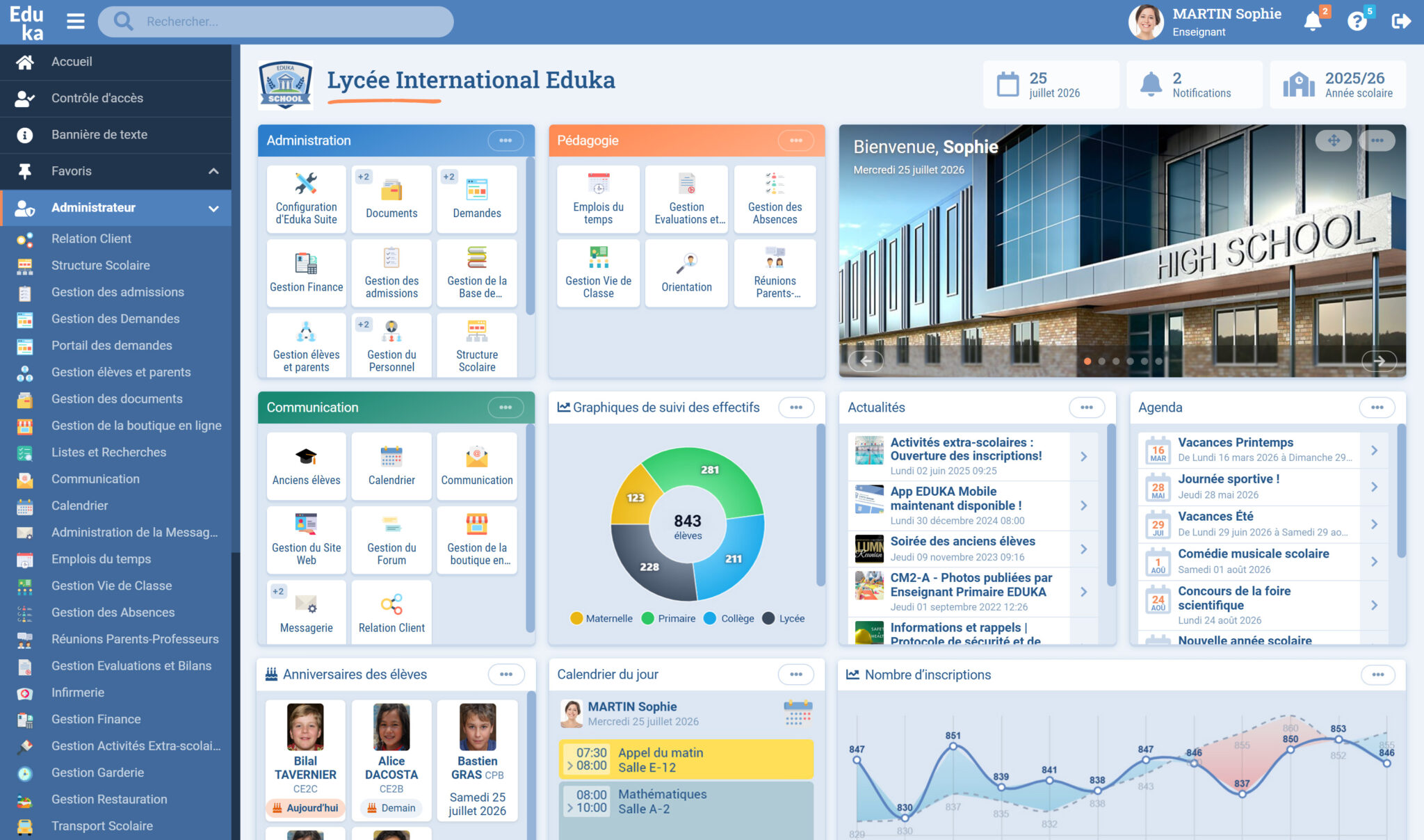
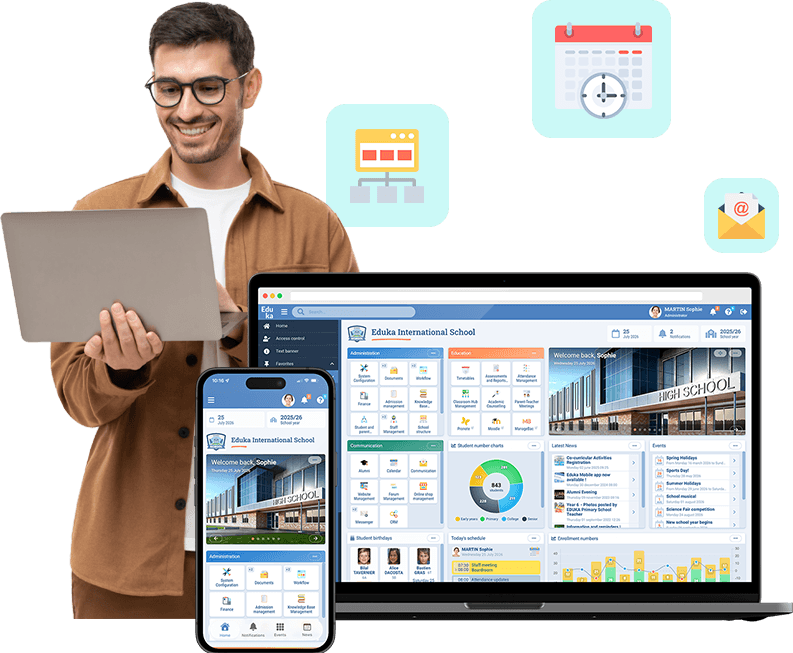
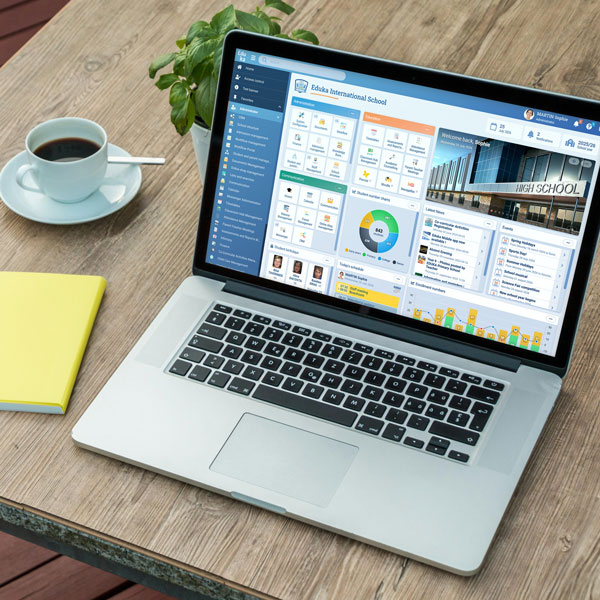
The suite integrates admissions, student and family management, finance, payments, services such as extracurricular activities, the cafeteria, and transportation, absences, schedules, assessments and reports, communication, documents, administrative workflows, and dashboards.
This approach allows each school to gradually build an environment tailored to its specific needs, without creating a multitude of disconnected tools.
For international schools, the challenge is clear: to have a platform capable of managing the entire family experience, from application to billing, school life, services, and day-to-day communication. la vie scolaire, les services et la communication quotidienne.
A school ERP system like Eduka does more than just store student data. It helps schools better organize their processes, ensure the reliability of their information, and improve the experience for all stakeholders.
What do you think?
This article is open for discussion in the Eduka Community. Ask your questions and share your experience with other schools.