






























International schools are often organized across multiple campuses, grade levels, or locations. While this structure helps meet the needs of families and support the school’s growth, it also makes day-to-day management more complex.
Scattered student data, varying processes across locations, difficult reporting, fragmented communication, and more complex billing: without a centralized platform, managing multiple campuses can quickly become a burden for staff.
An educational MIS (Management Information System) or SIS (Student Information System) connects data, services, and processes within a shared environment while maintaining an organizational structure tailored to each campus. What are the 5 benefits of using an educational management system like these?
1. Centralise student and family data
In a multi-campus school, information can quickly become scattered across multiple teams, files, or tools.
A school MIS/SIS like Eduka allows you to consolidate student data, parent information, classes, grade levels, departments, and documents into a single database. This prevents duplicate entries, data entry errors, and synchronization issues between locations.
The goal is not necessarily to standardize every aspect of how the school operates, but to ensure that essential information remains reliable, accessible, and up-to-date.
2. Standardize processes without sacrificing flexibility

Each campus may have its own customs, constraints, and unique characteristics. The risk is that this could lead to overly diverse operating procedures that are difficult for management to oversee.
A school MIS/SIS helps streamline key processes:
- reporting.
- admissions ;
- registrations;
- billing ;
- payments ;
- absences ;
- services ;
- communication ;
- documents ;
But it must also allow for a certain degree of flexibility depending on the location, grade level, or academic cycle.
3. Bolster financial and administrative management
Managing multiple campuses makes reporting more complex. Management needs to be able to answer simple questions:
- How many students are enrolled per campus?
- Which student levels are growing?
- What charges were billed to parents?
- Which payments are pending?
- Which school services are used most often?
- Which school processes take the longest?
- Which families still have steps to complete (for example in enrollment)?
A school MIS/SIS consolidates information and provides school administrators with a comprehensive overview, while also enabling analyses by campus, grade level, department, or time period.
This is particularly useful for budget management, workforce planning, and strategic decision-making.
4. Simplify the experience for parents

In a multi-campus school, families may have several children attending different locations. Without a centralized platform like Eduka, this can make the parenting experience more confusing.
A single parent portal makes it easier for families to access important information:
- administrative data;
- invoices;
- payments;
- absences;
- activities;
- documents;
- communications ;
- schedules;
- Practical information.
For the school, this reduces repetitive requests and scattered communication. For parents, it creates a more consistent experience, even when children are enrolled at different campuses.
5. Support the institution’s growth
A multi-campus organization often evolves over time. An institution may open a new campus, add a new program, restructure its academic levels, or develop new services.
A school information management system (MIS/SIS) must be able to support this growth without forcing the school to start from scratch. The platform must allow for the scalable organization of data, access rights, user profiles, processes, and dashboards.
For an international school, this ability to adapt is essential. The software must not only meet current needs; it must also be able to support the school’s future growth..
Eduka Suite: a platform designed for complex school systems
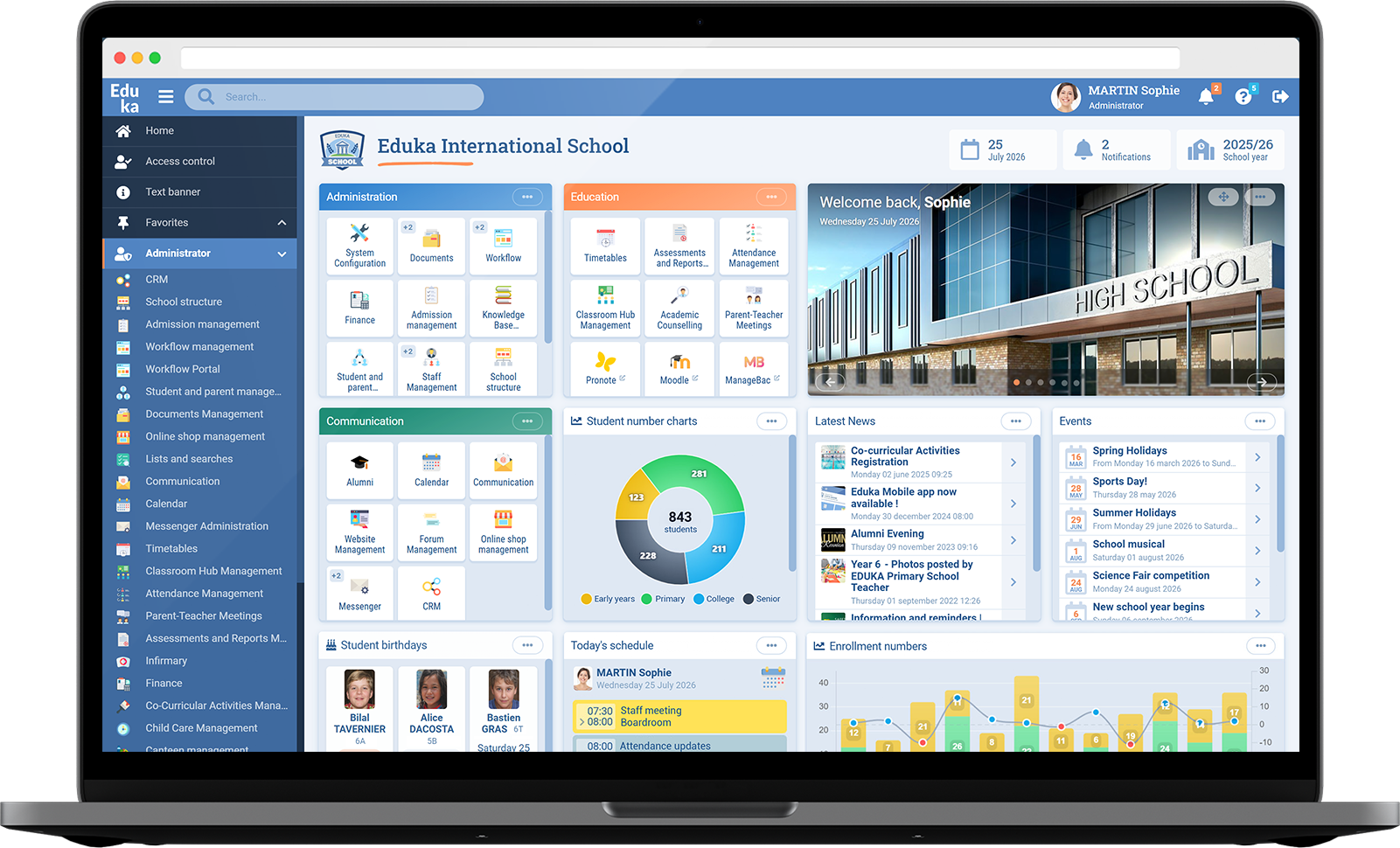
Eduka supports international schools in the centralized management of their administrative, financial, educational, and service operations.
The platform allows you to organize data by institution, campus, level, or profile, while maintaining a comprehensive view of the organization. Discover its academic structure module, designed for multi-campus management:
Teams can manage admissions, students and families, finances, services, absences, schedules, assessments, communication, and documents in a connected environment.
This approach is particularly useful for multi-campus schools that want to standardize their processes, improve data quality, and strengthen their institutional management.
What do you think?
This article is open for discussion in the Eduka Community. Ask your questions and share your experience with other schools.