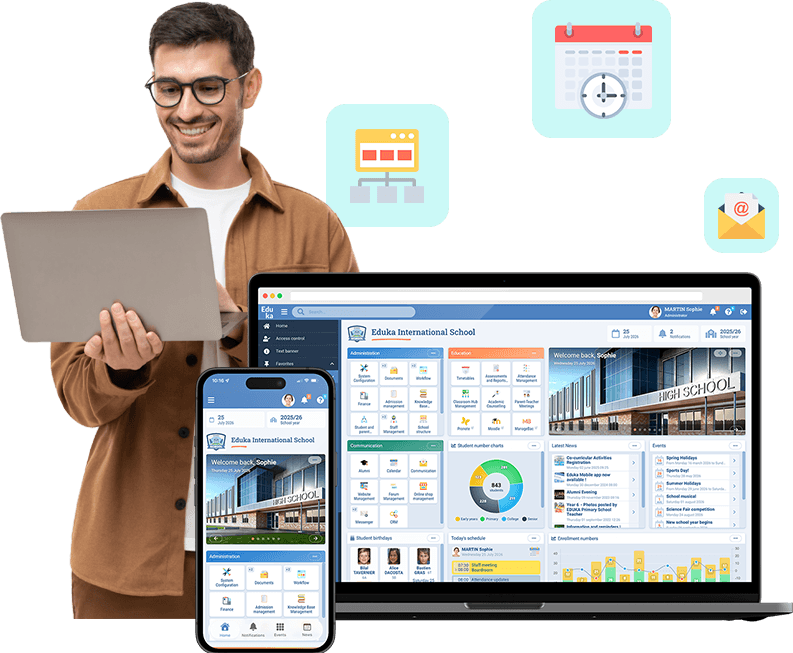































In most schools, there is an invisible but costly divide between two worlds: on one side, the school management software that handles enrollment, tuition, billing, and payments; on the other, the accounting software that generates balance sheets, journals, and financial statements.
The data from these two systems do not necessarily align. An accountant or a member of the finance team exports the billing data from the school’s software, reformats it in a spreadsheet, and imports it into the accounting software. This process, repeated every month, is a source of friction, errors, and a considerable waste of time.
Accounting integration (that is, the automatic connection between school management software and accounting software) is the solution to this problem. Here’s why it has become essential for modern schools.
The Problem of Double Data Entry: The Hidden Costs and Underestimated Risks
🕒 A considerable time investment
Double data entry (entering the same data into two different systems) is the silent enemy of financial efficiency. In a medium-sized school, this task can take up several hours a week sometimes even more during monthly or annual closing periods. This time isn’t just wasted; it’s spent on a task that adds no value. Ideally, an accountant or financial manager should devote their expertise to analyzing financial data, not to transferring it from one system to another.
⚠️ A risk of systematic error
Every manual entry presents an opportunity for error. A misplaced decimal point, an incorrectly entered account, or a missing line—these errors can go unnoticed for weeks and distort financial statements. In a multi-currency environment, the risk is even greater: an exchange rate error can result in a significant accounting discrepancy.
📄 A laborious monthly closing
The end-of-month accounting close is often a stressful time for schools’ finance teams. Reconciling billing data with payments received, verifying balances, correcting errors, generating journal entries, and so on, takes time. Without automatic integration, this process is unnecessarily prolonged.
The benefits of true accounting integration
A well-designed accounting integration radically transforms these processes. Here’s what it actually enables:
- Automatic synchronization of journal entries: Every financial transaction generated in the school software (issuing an invoice, recording a payment, generating a credit memo, applying a discount) is automatically converted into an accounting entry and transmitted to the accounting software. No human intervention is required for this transmission.
- Configurable accounting mapping: Schools have specific chart of accounts that vary by country, the school’s legal status (nonprofit organization, private company, public institution), and local regulations. Proper accounting integration allows you to configure the mapping between the categories in the school management software (tuition, cafeteria, transportation, etc.) and the accounts in the school’s chart of accounts. This mapping is set up once and automatically applied to all transactions.
- Streamlined bank reconciliation: When the school software is connected to both the bank account and the accounting software, reconciliation becomes virtually automatic: payments received in the bank are identified, matched to the corresponding invoices, and accounting entries are generated without manual intervention. Discrepancies are flagged for manual processing.
- Exports in standard formats: For businesses that do not want real-time integration, or whose accounting software does not offer an API, exporting in standard formats (FEC for France, structured CSV formats, XML formats) allows them to transfer data in just a few clicks, in the correct format, without manual reformatting.
The Most Common Accounting Software Used in Schools
Schools use a wide variety of accounting software depending on their country, size, and status. Here are some of the most common ones:
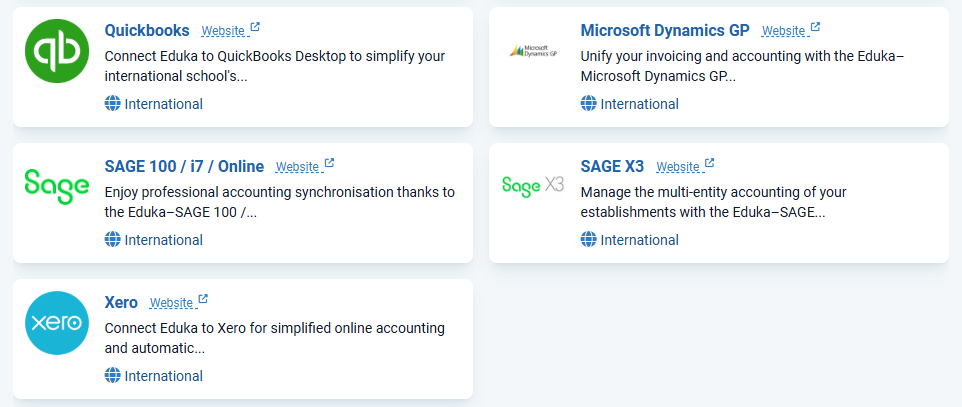
- Sage (in its various versions): widely used in France and French-speaking countries, particularly in private schools under contract with the government and school management associations.
- QuickBooks: popular in English-speaking institutions and international schools run by educational groups.
- Xero : a rapidly growing solution, particularly popular among medium-sized organizations in Commonwealth countries.
- EBP: Accounting: commonly used in small and medium-sized French organisations.
A good school management platform must be able to interface with these various tools, or, failing that, generate exports compatible with their import formats.
Accounting Integrations and International Schools: Specific Challenges
For international schools, the issue of accounting consolidation is particularly complex for several reasons:
- Multiple entities: An educational group that manages multiple schools in different countries may use different accounting software depending on the jurisdiction, with different chart of accounts. The integration must accommodate this diversity.
- Multi-currency: Transactions are conducted in multiple currencies, and the accounting records must reflect amounts in both the local currency and the reference currency. Managing exchange rate differences is a distinct accounting issue.
- Local tax compliance: Each country has its own rules regarding VAT (or equivalent), electronic invoicing, and the retention of accounting records. The integration must comply with these local requirements.
- Consolidated Reporting: The management of a network of international schools needs a consolidated financial overview of the entire group, in a single currency. This requires consolidation mechanisms within the accounting software or school management software.
The Eduka Approach: Native Integrations and Flexible Exports
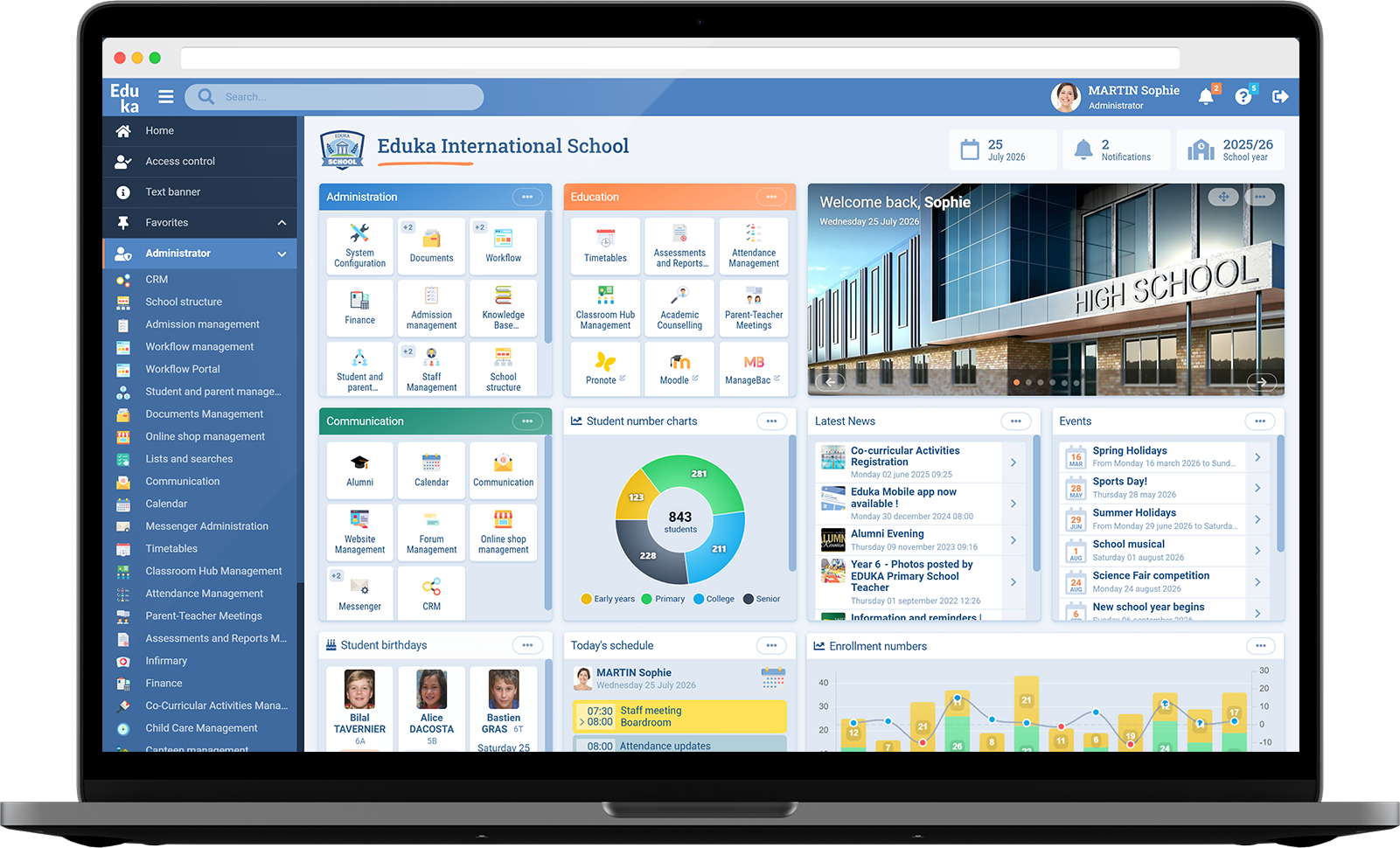
Eduka offers native accounting integrations with the leading software solutions on the market, as well as exports in the standard formats used by finance teams and certified public accountants. Accounting mapping settings can be configured directly from the administration interface, without requiring technical assistance. Exports can be scheduled automatically at a set frequency (daily, weekly, monthly) or triggered manually on demand.
For school groups comprising multiple institutions, Eduka offers centralized financial data management with consolidated reporting capabilities, while respecting the specific accounting requirements of each entity.
Conclusion
Integration between school management software and accounting software is not a technical detail; it is a strategic choice that directly impacts the reliability of financial data, the workload of the finance team, and management’s ability to steer the institution using up-to-date figures. In a climate where schools are facing increasing financial constraints and heightened transparency requirements, a well-designed accounting integration is an investment that pays for itself quickly.
Would you like to understand how Eduka integrates with your current accounting software? Our team can conduct a customized assessment of your integration needs.