































The start of the school year doesn’t begin on the first day of school; it all happens in the weeks leading up to it. Re-enrollment, class formation, schedules, billing, enrollment in after-school programs, opening access for families… For administrative staff, September is the convergence point for dozens of tasks that, taken together, determine whether the year will start off smoothly or in a rush.
At international schools, the situation becomes even more complicated: families arriving and leaving during the summer, documents in multiple languages, tuition fees in multiple currencies, and a number of new students that sometimes doesn’t stabilize until the last minute. This article provides a structured administrative checklist to follow before, during, and after the start of the school year.
Why the start of the school year brings all the administrative workload
Three factors come into play at the start of the school year. First, the year-end transition: we must close out the previous year (archiving, finalizing invoices, staff departures) while opening the next one (new students, new class structure). Then comes the influx of updated information: family contact information, medical records, consent forms, and service selections (school lunch, transportation, extracurricular activities)—all of which must be collected, verified, and validated within a few weeks. Finally, the pressure of the schedule: everything must be ready for a fixed start date that’s set in stone.
The Back-to-School checklist for administrators
1️⃣ What do before the start of the school year (June through August)
This is the most important phase, and the one that determines everything else.
- Re-enrollments and withdrawals: Confirm re-enrollments, record withdrawals, and update actual enrollment figures.
- Student and Family Information: Update contact information, emergency contacts, medical information, and authorizations (leaving school, image rights).
- Structure and organization of classes: define levels, groups, classes, and assignments; plan for scenarios involving multiple sites or multiple cycles.
- Schedules: create and review schedules, assign classrooms and teachers, and resolve conflicts before publication.
- Annual Billing: Generate tuition bills, set up payment schedules, currencies, and payment methods; send out the first invoices.
- After-school services: Open registration for the school cafeteria, transportation, after-school care, and extracurricular activities, along with the associated billing.
- Documents and Contracts: Prepare enrollment contracts, school policies, and consent forms to be signed—ideally via electronic signature to avoid back-and-forth paper exchanges.
- Accounts and Platform Access: Create accounts for new students, families, and staff; test access before the big day.
- Pre-school-year communication: Send practical information, key dates, and instructions on how to access digital tools.
2️⃣ Kickoff and the first week
- Welcoming New Families: Issuing login credentials and providing assistance with the first login to the parent portal.
- Attendance tracking : Start tracking absences and tardiness on the first day.
- Last-minute adjustments: class reassignments, schedule changes, late registrations.
- Distribution of materials: login credentials, calendars, and back-to-school documents—all centralized and accessible online.
3️⃣ After the start of the school year (September)
- Ensuring the accuracy of the lists: verify that the student enrollment figures, classes, and departments match the actual situation on the ground.
- Billing Follow-Up: Send reminders for the first overdue payments; adjust invoices related to late registrations or changes in services.
- Back-to-School Review: Identify areas of friction (bottlenecks, tasks done twice) to improve the process next year.
Common Pitfalls at the Start of the School Year (and How to Avoid Them)

The first pitfall is multiple data entry: the same information (an address, a cafeteria choice) entered into multiple files will eventually become inconsistent. Data entered just once and then shared across departments eliminates this source of error.
The second is working in bubbles: administrative, educational, billing, and after-school programs each operate independently, without a shared view of actual enrollment numbers. The result: discrepancies begin to emerge.
The third issue is late communication with families: when parents receive their login information or bills on the first day of school, it leads to a surge in calls and emails that the administrative team struggles to handle. Sending out pre-school-start communications in advance automatically eases the workload during the first few days.
Streamline the start of the school year with an integrated platform
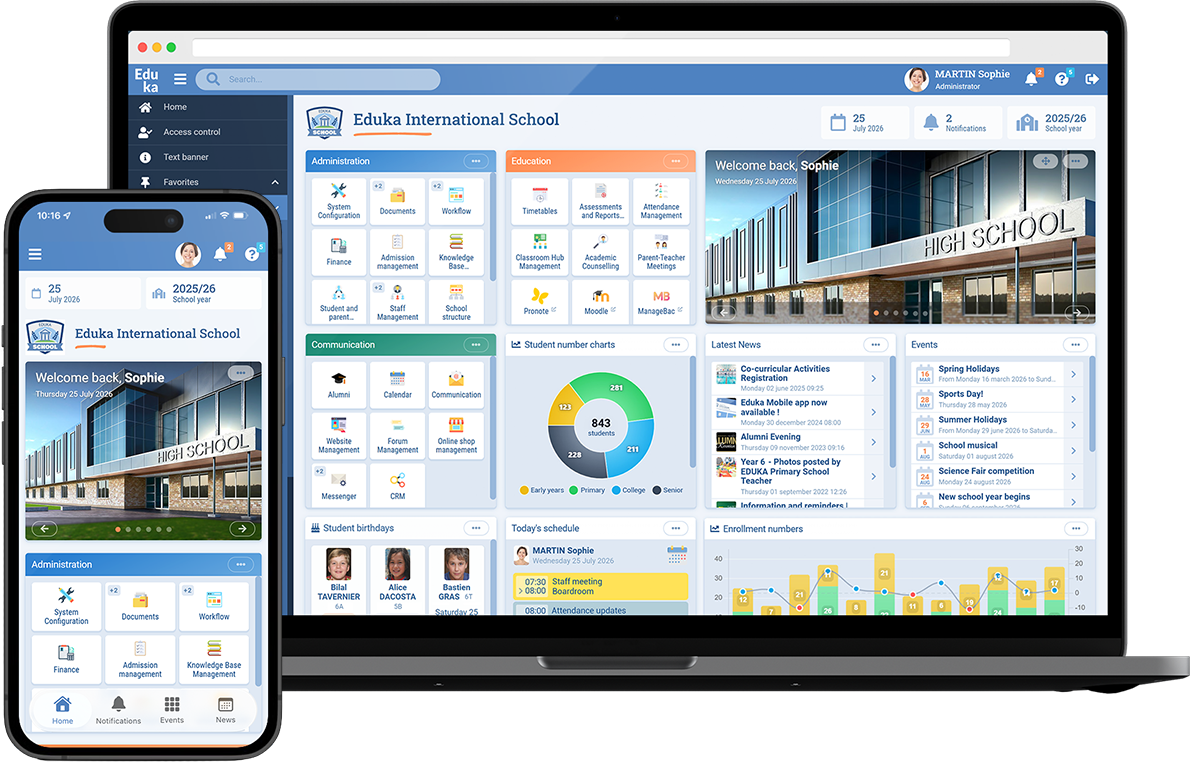
Most of these tasks share the same basic data: who the students are, which classes they’re in, what services they receive, and how they’re billed. Centralizing them on a single platform transforms the start of the school year from a high-pressure sprint into a smooth, controlled process.
With a suite like Eduka, re-enrollments and new admissions, class structure, schedules, multi-currency billing, enrollment in after-school programs, electronic signatures on documents, and the parent portal are all based on a single database. Information entered in one place is reflected everywhere: a confirmed re-enrollment automatically updates the class roster, the schedule, billing, and family access. Teams save time, families have a single point of access, and preparations for the new school year can be made without creating multiple files.
In summary
A successful start to the school year is one that’s well-prepared: planned as early as June, organized around a clear checklist, and backed by reliable, centralized data. This involves treating the administrative phase as a project in its own right, with its own steps and deadlines.
What do you think?
This article is open for discussion in the Eduka Community. Ask your questions and share your experience with other schools.