























Running a school creates a considerable administrative workload: admissions, attendance, billing, timetables and communication with families. To cope with it, primary schools, secondary schools, sixth forms and higher education institutions are increasingly turning to school management software, whether a school ERP (Enterprise Resource Planning) system or a virtual learning environment.
But what does school management software actually cost? Between promises of free software and bespoke quotes, it is essential to understand the pricing models, the price ranges and, above all, how to measure the return on investment (ROI).
1. The four main pricing models
The price of school management software depends first and foremost on how the vendor chooses to sell it. There are four main models:
- SaaS (Software as a Service) / subscription: This is the most common model in 2026. The school pays a monthly or annual subscription. The advantages are a low entry cost, automatic updates and cloud hosting included. The price is often based on the number of pupils or users.
- Perpetual licence (on-premise): The school buys the software outright. This model is increasingly rare. It suits organisations with their own IT infrastructure and strict data sovereignty requirements. It does, however, come with annual maintenance fees (typically 15 to 20% of the purchase price).
- Open source: The software’s code is free (e.g. some community-driven solutions). However, this model hides real costs: hosting, customisation, security and technical maintenance, all of which require an external provider or an in-house IT team.
- Modular (à la carte) model: The school only pays for the features it needs (e.g. an “attendance and pastoral” module plus a “billing” module, without the “transport” or “catering” modules). This allows the budget to match actual needs.
2. School management software cost in 2026: estimated price ranges
Prices vary enormously depending on the size of the school and the features required. Here are some orders of magnitude observed in the French-speaking market:
- Small settings (nurseries, micro-schools, under 100 pupils): Between €0 and €300 a month (i.e. €0 to €3,600 a year). Some solutions offer limited free versions or very affordable “Starter” plans for small organisations.
- Medium-sized schools (primary and secondary schools with 100 to 2,000 pupils): Expect to pay between €300 and €1,000 a month (i.e. €3,600 to €12,000 a year). At this level, pricing is often a flat fee or rises slightly with pupil numbers.
- Large organisations and school groups (over 3,000 pupils, higher education): Prices are quoted on request. They can range from €10,000 to over €50,000 a year, including advanced features (HR system integration, banking APIs, complex student portals) and dedicated support.
3. Hidden costs to factor into your budget

The licence or subscription fee is only part of the equation. To avoid unpleasant surprises, your budget should account for the Total Cost of Ownership (TCO):
- Set-up fees (onboarding): Importing existing databases, configuring your specific business rules and setting up timetables.
- Staff training: Software that is poorly understood is software that goes unused. Plan training sessions for administrative and teaching staff.
- Support and maintenance: Check whether technical support (phone, chat, ticketing) is included 24/7 or charged as an extra.
- Additional hardware: Tablets for taking registers in class, local servers (if you choose on-premise) or an upgrade to the school’s internet bandwidth.
4. Return on investment (ROI): how does the software pay for itself?
The ROI of a school ERP is not measured in money alone, but in overall efficiency gains. If you want to see figures, here is a basic calculation:
| Item | Assumption | Annual amount |
|---|---|---|
| Fees billed | 500 pupils × €2,000 | €1,000,000 |
| Fewer unpaid fees | 1 percentage point recovered | + €10,000 |
| Administrative time saved | 50 hours a week × 36 weeks × €25 an hour | + €45,000 |
| Software cost | subscription, modules and fees included | − €8,000 |
| Net annual gain | + €47,000 |
The main drivers of return are the following.
4.1 Major administrative time savings
Automating repetitive tasks (generating reports, payment reminders, attendance management) frees up time for staff. A well-equipped school sees real day-to-day time savings, allowing staff to focus on higher-value work.
4.2 Fewer unpaid fees and errors
Automated billing, combined with direct debit and SMS/email reminders, drastically reduces late payments from families. Removing manual re-entry also limits costly errors (overpayments, missed invoices).
4.3 Better retention and a stronger brand image
A smooth, modern parent and pupil portal improves family satisfaction. Transparent communication and digital services (booking school meals, tracking academic progress) have become deciding factors at admission, helping to keep pupil numbers stable.
4.4 Strategic decision-making
Real-time dashboards give leadership a precise view of attendance, profitability by class and budget forecasts. This type of software delivers a significant return on investment thanks to more accurate data and better-informed decisions.
5. Tips to optimise your choice and your budget
- Check GDPR compliance: Make sure the vendor hosts data in the UK or the EU and fully complies with the regulations on protecting children’s data.
- Prioritise user experience (UX): User adoption is the main driver of return on investment. If the software is too complex, staff will stick to their old ways of working, cancelling out any potential gains.
FAQ
Is pupil data secure?
Reputable vendors comply with the GDPR (UK GDPR in the UK) and host data on secure servers, often in Europe.
What is the average price of school management software?
In 2026, the cost generally ranges from €300 to €1,000 a month for a medium-sized school, depending on the SaaS model and the number of pupils.
Is school management software worth the investment?
Yes. ROI is often reached within 12 to 18 months, thanks to fewer unpaid fees, automated administrative tasks and staff time saved.
What about Eduka?
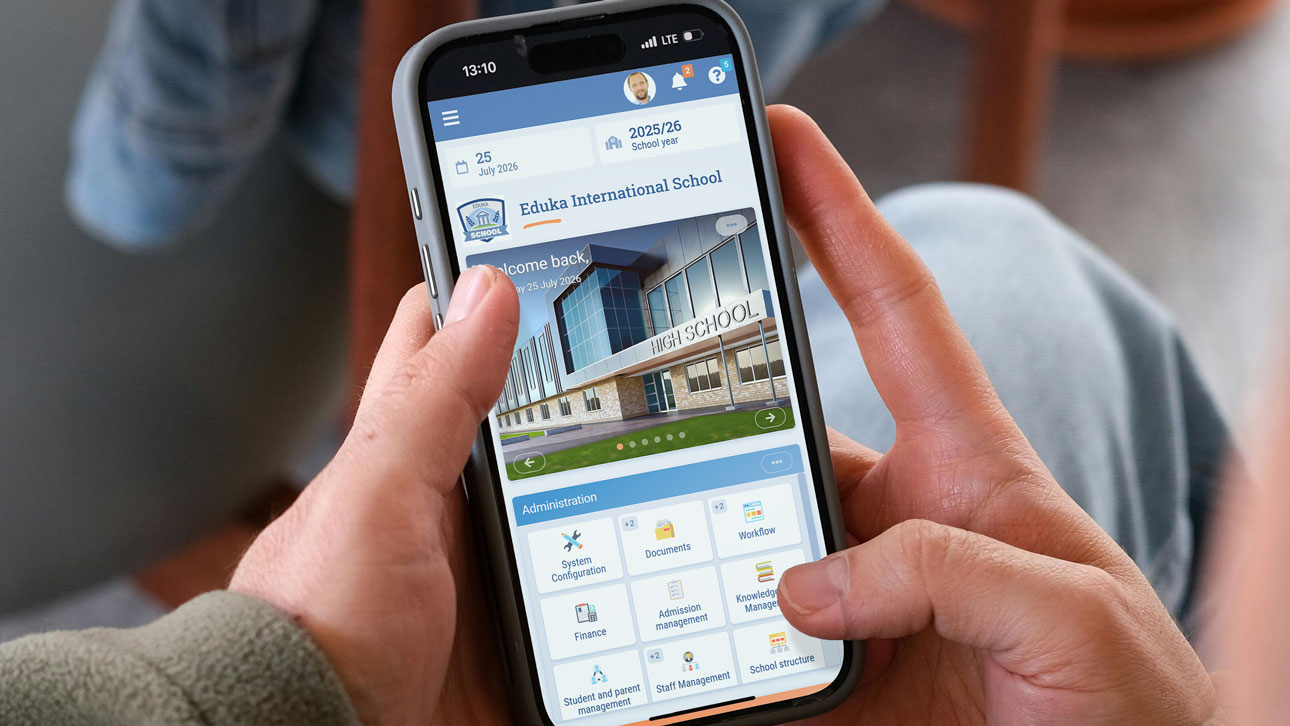
At Eduka, pricing depends on the size of your school and the modules you choose. The suite is modular: you only pay for what you use, and you can add modules at your own pace.
- Express: free for schools with up to 100 pupils. Includes 11 core modules and the mobile apps; support and data migration are self-service.
- Pro: from €55 a month. Adds the e-learning platform, multi-language support and helpdesk access for 3 users.
- Premium: priced on request. Helpdesk access for 5 users and one hour of support and training a month included.
Compare our plans on our pricing page, or request a quote tailored to your roll and the modules you actually need.