



























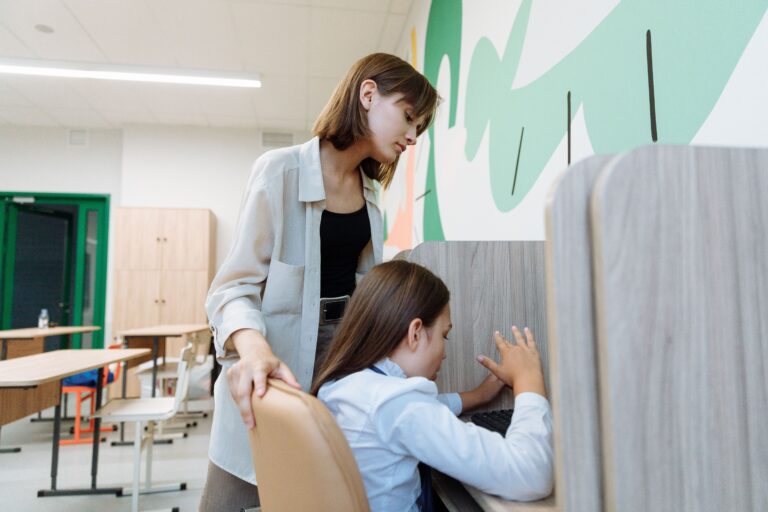


‘Correct the errors in this week’s spelling test.’ On Alexy’s work, the teacher has circled some errors and marked others in the margin. Alexy needs to find them and correct them. But how much help should his parent give? Should they provide the corrections or leave some errors unresolved?
This fictional situation illustrates a common difficulty in school–family communication: information can be passed on without the educational expectations being understood. The same question arises with a teacher’s comment, a meeting or a new classroom practice. For school leaders and teachers, the issue therefore goes beyond how an instruction is worded. This situation first invites us to consider how the school and the family coordinate their support.
Parent–teacher collaboration: connecting school and home
Developmental psychologist Urie Bronfenbrenner uses the term mesosystem to describe the relationships between the settings in a child’s life. This perspective encourages us to consider experiences at school and at home together.
Explaining the school’s expectations also means listening to families’ experiences and taking account of what they can do. Their feedback may lead the school to adjust what it asks of them.
Three functions can help the team examine its practices:
- Inform: make an instruction, an observation or a deadline available.
- Exchange: enable people to ask a question, clarify an expectation and share an observation.
- Collaborate: consider an action in which everyone knows their contribution and the proposed next step.
This distinction provides a practical guide to be adapted to each situation. For Alexy, the first step is to clarify the support expected: how can he be helped to remain actively involved in correcting his work?
Clarifying parents’ role in supporting pupils’ autonomy
‘Supporting your child’ can mean checking every answer, asking a few questions or simply setting aside some quiet time. Without further explanation, each family interprets the request through its own experience of school.
Among parents of primary school pupils, Deslandes and Bertrand (2004) observe that the factors associated with involvement differ between home and school: parents’ sense of competence, understanding of their role and invitations from teachers. The authors recommend equipping families with the support they need. However, this study does not test a particular way of wording a message.
An instruction can therefore explain what the child is trying to learn, what they can attempt themselves and what support the adult can offer. For Alexy, it might read:
Example of a message to the family:
Alexy needs to find the errors that have been marked and correct them, so that he understands what needs to change and why. You can ask him to explain his choice and encourage him to consult the classroom resources, without providing the correction. If he still does not understand an error, Alexy can put a question mark above it: we will revisit it in class. This mark is enough; there is no need to keep trying when he is stuck.
Here, the child works things out with an adult available to help: supporting autonomy does not mean leaving them to succeed alone. In their meta-analysis, Howard and colleagues (2025) associate psychological need support with better functioning at school, including engagement. Although their research does not test the effect of a message to families, it sheds light on the value of explaining reasons and offering appropriate guidance. There must also be a way to share what this support reveals about the pupil’s difficulties.
Involving families and pupils in reviewing learning progress

This feedback becomes useful when the family can share what they have observed. The review by Larivée and colleagues (2017) highlights, among other things, the importance of listening, clarifying responsibilities and adapting to the needs of those involved in school–family–community collaboration. For the school, this means explaining how to share an observation and what follow-up it may receive.
Alexy’s parent might therefore write:
‘Alexy corrected several errors on his own. We looked at the spelling rule together, but there are still two corrections he does not understand: Alexy has marked them with a question mark.’
The family describes the difficulty and the help provided; the teacher considers these alongside their classroom observations. An answer produced independently does not provide the same information as one reached after an explanation.
Here, the question mark is a code agreed with the teacher. It allows a persistent difficulty to be flagged after an attempt, without asking parents to provide every correction.
The pupil can explain their corrections and what they still do not understand, without the family becoming a constant assessor. The teacher retains responsibility for interpreting the learning evidence and making adjustments. For these observations to reach the teacher, families also need to know where and how to share them.
Communicating with parents: which channels should schools choose?
With support from school leaders, the team agrees common guidelines: where to find information, whom to contact, when to expect a reply and when to suggest a meeting. Families can then find their way around, while teachers can maintain boundaries around their availability.
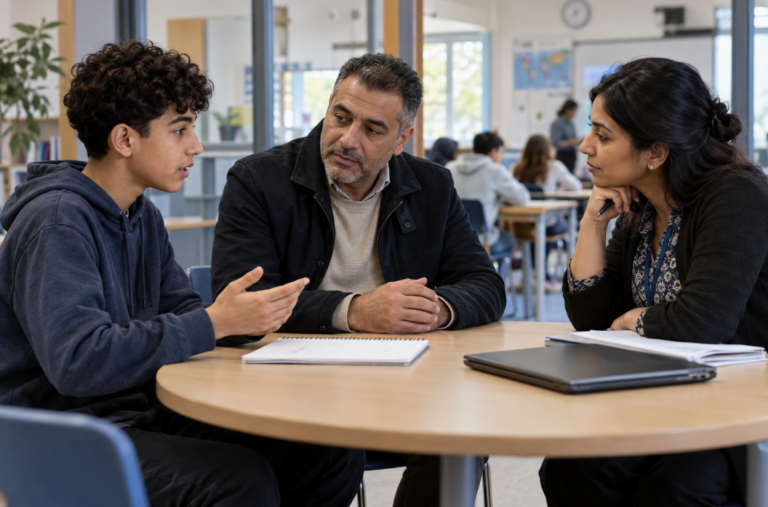
Opportunities to participate also vary. Working hours, language, access to tools or familiarity with the school’s expectations may all play a part. A late reply or absence from a meeting is therefore not enough to establish a lack of interest. Before interpreting this silence, the school can seek to understand what makes contact easier or more difficult.
Digital tools can make it easier to access information and resources, as well as to send a question after the working day. The systematic review by See and colleagues (2020) reports encouraging findings for some communication interventions, while highlighting the limitations of the available evidence. It does not establish a general educational benefit from using a platform.
The channel depends on the need and on what is possible for those involved. Here are some guidelines for the team:
| Communication need | Possible channel | Point to consider |
| Finding an instruction or a resource | Portal or shared space | Clarify the purpose, deadline and support expected. |
| Asking a question or sharing an observation | Written message | State whom to contact and the expected response time. |
| Revisiting a persistent misunderstanding or a concerning situation | Conversation, remotely or in person | Clarify different perspectives and agree on a next action. |
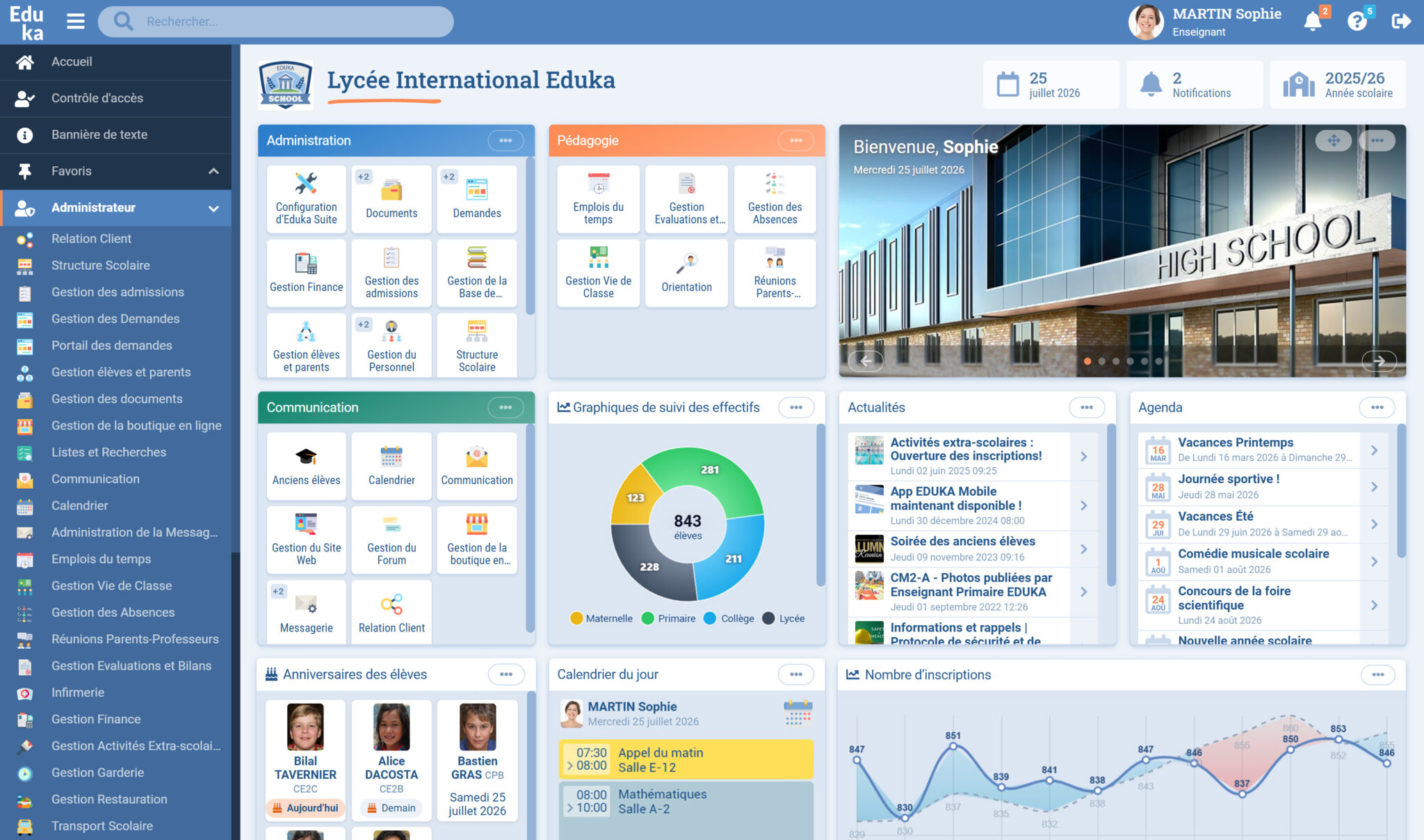
Eduka’s Classroom Hub module, part of its school management software, enables schools to share content and documents with families, who also have a tab for contacting teachers. For Alexy, the team could use it to explain the support expected and the correction code. The messages still need to be examined: do families know what help to provide, how to report a difficulty and what follow-up to expect?
Improving messages to families: three questions for the team
At an upcoming team meeting, school leaders could suggest revisiting a recurring message: an instruction about correcting work, an invitation to a meeting or information about learning.
Three questions can guide this review:
- Is the purpose explicit? What should the pupil learn, or what should the exchange make possible?
- Is everyone’s role clear? What can the child try, and with what support from the adult?
- Is follow-up possible? How can someone ask for clarification or flag a difficulty?
Once the message has been sent, some feedback from families can guide adjustments: adding an example if the expected support remains unclear, or changing channels if access is a problem. This feedback sheds light on how the message is understood, without measuring its educational effectiveness. For Alexy, the next step is to revisit the errors marked with a question mark with the teacher, explaining the corrections he tried and the help he received.
School–family communication can thus connect explicit expectations, dialogue and a clear educational next step in which the pupil retains an active role.
References
Deslandes, R., & Bertrand, R. (2004). Motivation des parents à participer au suivi scolaire de leur enfant au primaire. Revue des sciences de l’éducation, 30(2), 411–433. https://doi.org/10.7202/012675ar (in French)
Howard, J. L., Slemp, G. R., & Wang, X. (2025). Need support and need thwarting: A meta-analysis of autonomy, competence, and relatedness supportive and thwarting behaviors in student populations. Personality and Social Psychology Bulletin, 51(9), 1552–1573. https://doi.org/10.1177/01461672231225364
Larivée, S. J., Bédard, J., Couturier, Y., Kalubi, J.-C., & Larose, F. (2017). Les pratiques de collaboration école-famille-communauté efficaces ou prometteuses : synthèse des connaissances et pistes d’intervention [Rapport de recherche]. Fonds de recherche du Québec – Société et culture. https://t.ly/Sy5j3 (in French)
See, B. H., Gorard, S., El-Soufi, N., Lu, B., Siddiqui, N., & Dong, L. (2020). A systematic review of the impact of technology-mediated parental engagement on student outcomes. Educational Research and Evaluation, 26(3–4), 150–181. https://doi.org/10.1080/13803611.2021.1924791
About the author
Emmanuel Bernet, Ph.D.
Teacher, researcher, trainer and international consultant
PhD in Educational Sciences, Educational Psychology (Université de Montréal)
Master’s in Training Practice and Engineering (Université de Bordeaux)

With 30 years of experience in schools, in Quebec and abroad, he supports school teams with competency-based assessment and the quality of feedback, through evidence-based approaches adapted to their context. For example, he runs workshops on building descriptive rating scales and on the collective analysis of student work, using artificial intelligence. Shared tracking of observations and teaching decisions helps teams adjust their practice and follow their progress.
What do you think?
This article is open for discussion in the Eduka Community. Ask your questions and share your experience with other schools.